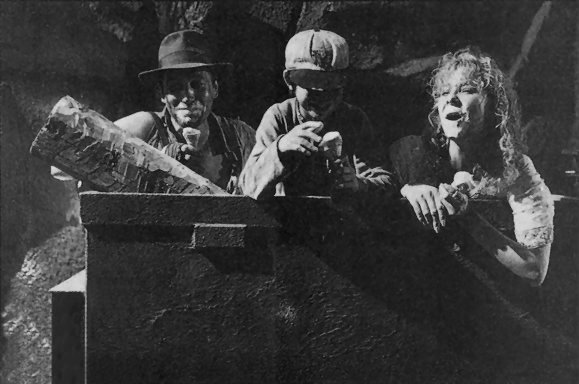
| After filming in
Sri Lanka, the production moved to EMI
Elstree Studios outside London to shoot
the remaining half of the film's footage. Early
plans to film in Australia were scrapped due to
lack of studio space, construction materials and
technically skilled engineers.
EMI,
aka "Lucas East," had made available
every soundstage, including the monolithic Stage
6, which served the Star
Wars crew perfectly. Actually, there were
about 9 stages and in some cases they had stages
that converted to other sets. Much of the budget
was spent on the sets and on the ILM
special effects, which outnumbered what they had
in Raiders. This
time they had roughly between 150 and 160 effects
shots, which is nothing compared to Return
of the Jedi, but still a lot for this kind
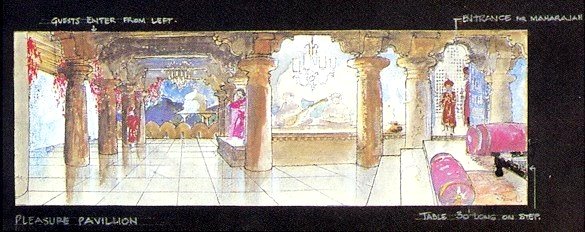
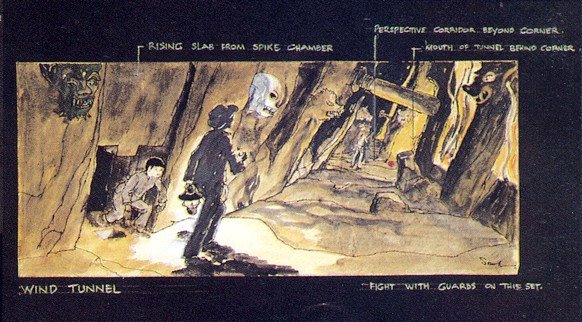
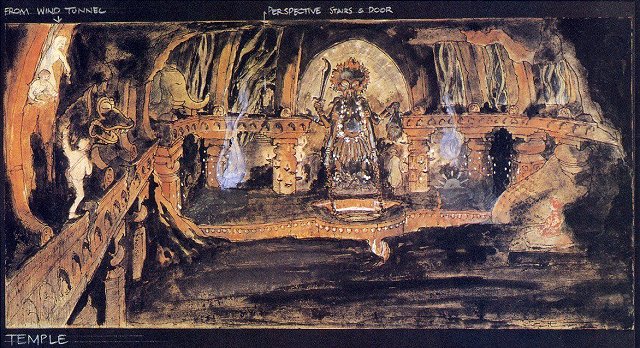
of picture. Elliot Scott erected the Palace of
Pankot in its entire exotic splendor, using enough
raw materials to supply a small country. Equally
elaborate sets included mines and a stone quarry.
Crews had built, dismantled and rebuilt with the
choreographed precision of a Marine drill unit.
As testimony to Scott's talent, new sets appeared
almost overnight, ready for filming the next day.
It was a vast business to create this many sets.
At one point they had about sixty plasterers alone
at work.
  
Pleasure pavilion,
wind tunnel and temple set design illustrations. |
Shooting was going well under schedule
when something unpleasant came up. Mounting the
elephants for many hours of shooting in Sri Lanka
exhausted Ford bringing in the surface an old
back problem and by the time the crew stepped
in London he was in such a pain that made Spielberg
sent him in the United States for urgent attention.
He was taken to the Centimella
Hospital in L.A. that is specialized in
sport injuries, and there doctors immediately
diagnosed a ruptured disc. Doctors in order to
avoid the painful operation treatment tried a
revolutionary new technique. According to this
technique an enzyme coming from Papaya fruit would
eat way at the disc. The results were very impressive,
although Ford was ordered to rest - which resulted
in an insurance bill in excess of $1 million.
According to Lee Pfeiffer and Michael Lewis' book
The Films of Harrison
Ford, Ford's friend Howard Becker visited
him in the hospital and described the actor's
concentrated efforts to hasten recuperation: "After
the operation, he used a relatively tenacious
and disciplined rehabilitation-stretching, a type
of yoga, if you will. He was working his muscles
very hard. I was worried, I kept telling him to
slow down. As a former athlete, I had a track
scholarship at college; I know that strong people
can sometimes come back too fast. But he healed
completely, and did it faster than the doctors
expected. He's a very strong-willed person."

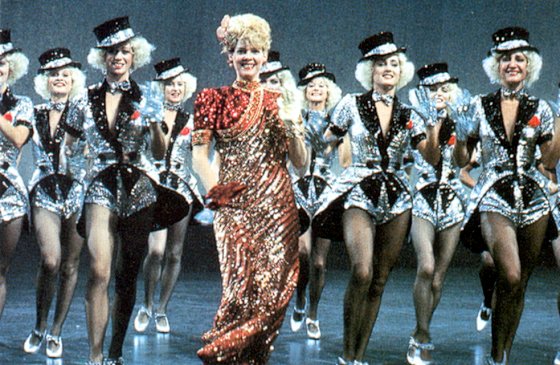
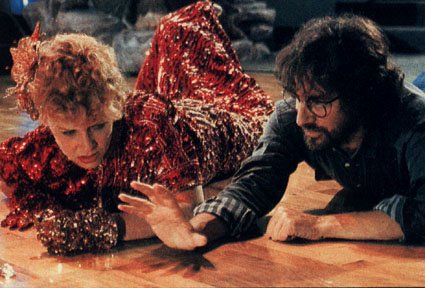
Kate Capshaw dancing. |
|
Back in London and during his absence
Spielberg rearranged sequences to shoot around
Ford, this wasn't easy since the actor was in
most of the scenes. Among the scenes filmed during
Ford's absence was opening credits dance part,
reminiscent of Berkley's musicals. "It was
a pleasure to direct because I always wanted to
make a musical movie from start to end. And I've
been a little frustrated by that urge because
so many things had come up in my life." Danny
Daniels was the choreographer.
Despite Spielberg's innovations
the production shut down for three weeks. During
that period they went to the US and did some second
unit work. When Ford returned, they returned to
England and shot for a further three weeks. Completing
their work in London they went back to the US
for two more weeks.
The week following Ford's return
on the set started the filming of the Club Obi
Wan sequence. Spielberg shot the opening sequence
for three days, assembling the action, as usual,
to a mental plan. By this time, the script was
beginning to crumble from repeated changes, many
of them dictated by Ford's back. Spielberg stopped
shooting a number of times, called for a typewriter
and wrote new lines on the spot. At night he was
on the phone to friend John Milius, who dictated
dialogue from L.A.
 
Spielberg talking
with, then future wife, Kate Capshaw and with
Lucas. |
On the third day, with the club
half-demolished, Spielberg arrived on the set
and said, "Let's go back to the scene at
the table. I know how to do it now!" unaware
that the table with its revolving 'Lazy Susan'
centerpiece had been irretrievably smashed. The
assistant director managed to find another one
and for half a day Spielberg reshot the by-play
with the diamond, the urn and the antidote vial.
With Ford's back not fully recovered
all his work fell on Vic Armstrong, his stunt
double. Armstrong had worked with him several
times before and a friendship had grown between
the two men. Armstrong's uncanny resemblance with
Ford helped the production a lot. Ford once said
jokingly: "We could go home to the wrong
wives and they wouldn't notice!" Even Spielberg
used to get the pair muddled up on the set of
Raiders. Vic Armstrong
shared the same sentiments with Ford, "We
really are spitting images. Harrison's a really
super guy. The man you see on screen is the man
you see in real life. He's an absolute perfectionist."
Ford acknowledged that he could never have done
Indy II with out
Armstrong.
Assistant director David Tomblin
commented on the subject, "I take my hat
off to Spielberg, because we never stopped shooting
in those three weeks, and it wasn't stuff that
one would say, 'Oh that's a double.' Then Harrison
came back, and we shot more material. I defy anyone
to know who's the double and who's Harrison. I
have great admiration for Steven Spielberg. He
is very unusual and talented director and he overcomes
hurdles, not only does he overcome them, he makes
something good of them, which is a rare talent."

Chief guard fight scene. |
|
Despite his ability to continue
filming action scenes, it was clear to everybody
that Ford was in significant pain. He made some
of the needed scenes, like the fight with the
Palace's chief guard, played by Pat Roach, in
great pain and he forced himself to continue like
this without complaining just for once. Still,
he to being a bit nervous about resuming the intense
physical demands of his role: "At one point,
the guard throws me into a mine car, and since
I had just come back from back surgery, I had
second thoughts about being the throwee!"
The crew watching Ford's dedication to do his
job, no matter how he felt, decided to make him
lighten up and overcome his distress.
Pat Roach remembers, "There
was a whipping scene where Harrison's tied up
to a rock. Barbra Streisand came in, dressed in
black leather, and while Harrison was chained
up to the rock, she took my whip off me and whipped
him! She said, 'That's for Hanover
Street, the worst movie I ever saw!' and
then she whipped him for doing Star
Wars and earning all that money. Then Carrie
Fisher ran in-she was dressed up, too-and she
threw herself across Harrison, and shouted, 'No,
no, no!' And then Irvin Kershner ran in and said,
'Steven, is this the way you run your movies?
I would never let this happen on one of my sets!'
Then, Steven said to Kersh, 'Get off my set!'
They filmed it, and I think they sent it back
to Hollywood. It was hilarious."

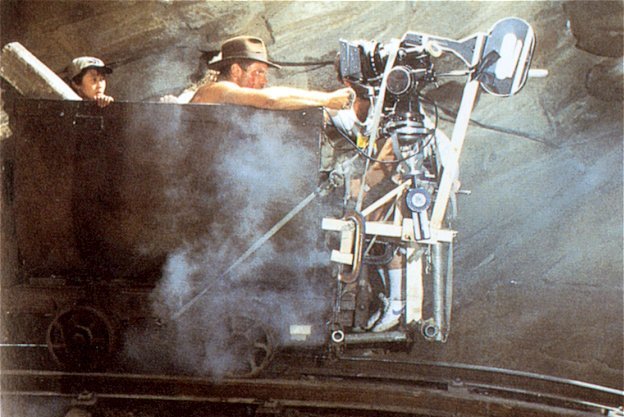
Filming
a mine chase close-up of Ford. |
|
After that the mood was more lighten
up but hard work was expecting them. Next for
filming was another danger-laden episode that
occurs at the film's climax, in a mine beneath
the Temple of Doom,
as the daring adventurer must narrowly avoid death
in a manner never before seen on film. The mining
car action has him in peril up to the brim of
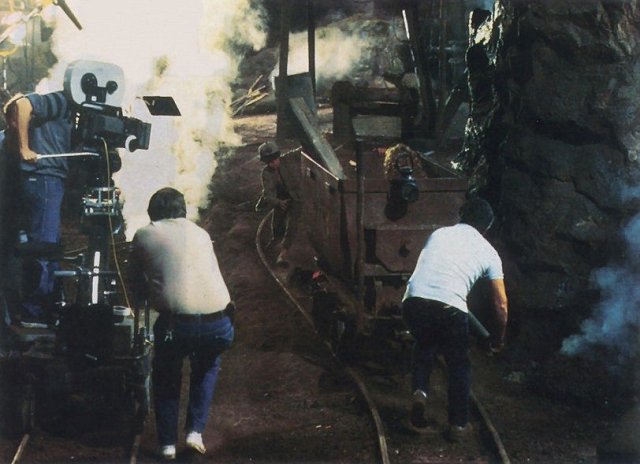
his rumpled fedora. Actually, Elliot Scott had
built a roller coaster where someone could take
rides in it. One circular track on three levels
with a total running distance of five or six hundred
feet. The center was all-open so the camera crew
could get in there to shoot and light it. Each
mine cars had independent electric motors in it
and was very controllable. Real mine cars were
bought and George Gibbs' department placed an
electric motor and batteries controlled by a hidden
motorcycle-type twist grip to each car. They also
installed disc brakes, plus the electric motors
had their own built-in braking system. Eventually,
they rigged up four cars, which could carry four
people each. Gibbs had to visit a lot of specialist
companies for help designing and building an asymmetrical
track plus installing steel flanges behind the
wheels to keep the cars on the track around curves.
To film the action Spielberg used master shots
with run-bys, or the camera in the car, running
next to the car with the actors. Before shooting
Spielberg made a steady test and discovered that
he couldn't get the camera steady. The photography
on the first day was unusable because the camera
shook too much when it was in the mine car. Spielberg
found that absolutely realistic and filmed the
entire scene this way. For certain shots he even
loosen the mounts of the camera to register more
vibration. While the actors were going around
in the mine car only at ten miles per hours, Spielberg
adjusted his camera to shoot in lower speed in
order to show them running twice as fast. But
the complete round of the soundstage was made
in just twenty-five seconds and he wanted his
scene to last at least seven minutes. So, with
the help of Douglas Slocombe, he shot every trip
the mine car made from a different angle and with
different lighting, creating the illusion that
each shot was taken from a completely different
section of the mine-tunnel. The scene would be
completed in post-production with the use of miniatures.
 
Filming the
mine chase and the cast taking a break. |
For the campfire scene, taking place
in the jungle, a menagerie of wild animals including
owls, elephants, snakes and an infant chimpanzee
were imported from around the world, and housed
on the British set. A bull elephant borrowed from
the London Zoo
settled in a mobile trailer used to swaying until
the entire van heaves on its frame! "The
best animal we used in this movie was Oscar the
Owl. Oscar had belonged to his handler since it
was an egg, so he tended to identify with humans
rather than with other owls. We did about six
takes with Oscar. He always flew in and landed
exactly on cue. The best animal I ever worked
with... better than a lot of humans!" said
Watts forgetting his previous experience with
the monkey on the Raiders
set.
One of Temple's
most suspenseful scenes was the spike chamber
sequence. Inspired by the classic B-movie tradition
of hair-raising traps and split-second escapes,
a secret tunnel had been added to the plot as
Indy's deus ex machina. "The spike chamber
is a cliffhanger scene with strong comedic overtones,"
described Watts, "its very heart stopping."
Indy and Shorty wandering the tunnels under the
palace come to a subterranean cavern to confront
the dreaded room with deadly spikes bristling
from the floor and ceiling. Indy stumbles in a
fallible moment, setting the trap in motion. As
the room closes in, similar to the garbage scow
room in Star Wars,
Indy and Shorty turn to Willie for aid. In order
to provide the needed assistance Willie has to
face hordes of bugs. Repeating the great horror
scene of the Well of the Souls, Lucas and Spielberg
came up with chamber infested with a million of
live and crawling insects. Poor Capshaw had to
go through mental exercise every day to withstand
the fact that she had to be covered with the insects.
"The worst part was having large bugs placed
strategically on me where you can literally feel
all their legs sort of grip you. The special animal
trainer would start at my waist and my arms and
work up my shoulders and then he would start placing
them in my hair. And I would always be afraid
that they would start crawling into inside my
hair and I had just keep breathing and I closed
my eyes and everybody would be quiet on the set.
It was as good as working with bugs could have
been."
Marshal complained that handling
bugs proved to be far more difficult than directing
the snakes in Raiders.
"The bugs were much harder to work with than
the snakes we used for [that one]," he commented.
"You can 'arrange' a pile of snakes-add one
here or there. That's impossible with insects.
Believe me, we had a couple of terrible days at
Elstree due to bugs; days when we'd grind film
all day and night and get nothing usable. They
hate bright light, so the minute you dump them
in front of the camera, they run. If you don't
get everyone's hands out of the way the minute
you put them in, the shot is ruined. Mike Culling,
the animal trainer, would come on the set and
I'd say, 'We need more bugs! Not enough bugs!'
He'd groan, 'I just put two thousand down there!'
I found, too, that people were much more scared
by the insects than they were by snakes. Every
once in a while I'd hear this shrieks because
one of the bugs crawled through from the bug tunnel
to the tap dance rehearsal stage next door. Of
course, this was a bad place for any bug to be,
thirty-two girls tap-dancing away, so both the
insects and the girls would run like hell. Mutual
fear!"
Most of the things in Pankot Palace
were totally phony. The only real thing on the
set was the eels that came out of the snake. They
didn't bother the actors, but the two kids hated
them. Especially, Sanji who played the little
maharajah couldn't stand them. They couldn't use
one or two takes where the eels got too close
to him, he just didn't like them at all. The rest
of the stuff... the beetles had squashed-up banana
in them, and the monkey brains were a kind of
custard cream, with raspberry sauce on top.
After spending three weeks in Elstree,
"blue screen" shots were made in the
United States at Lucasfilm's
facility, at Marin County, while additional sequences
were completed at other northern California locations.
The interior of the Duesenberg, in which Indy
and Willie escape from the nightclub was done
in California at the UK shooting's end, several
months after the exteriors, as part of the post-production.
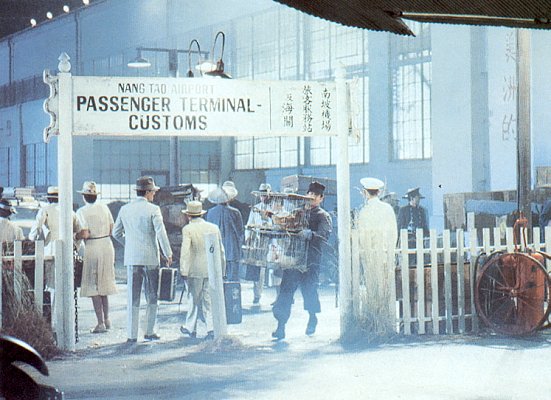
At the same time, they did the Shanghai airport
scene at the dressed-up Hamilton
Air Force Base just north of San Francisco.
That was actually the last day of principal photography.
This little scene was filled with cameos from
comic actor Dan Akroyd, as Weber the official
dispatcher at Shanghai airport, Frank Marshall
playing a coolie pulling a rickshaw, while Steven
Spielberg, George Lucas, Anthony Powell and Sid
Ganis appeared as missionaries waiting for the
airplane.
 
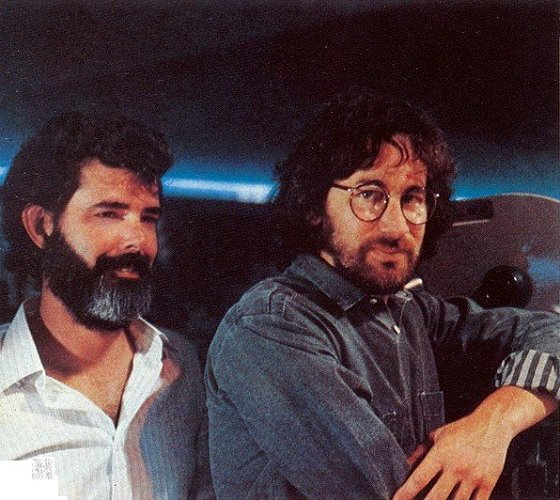
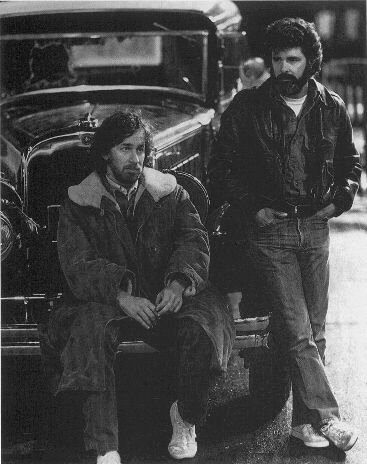
Steven and
George and the airport set. |
Principal photography completed
on September 8, 1983 after eighty-five days of
filming and five days under schedule with 18 weeks
of shooting and only four weeks on location. An
additional week's shooting with Ford took place
in March 1984 for completion of special effects.
At the same time Lucasfilm's
Vice President of Marketing, Sid Ganis, was present
at the 42nd World Science
Fiction convention to tantalize fans with
slides taken at the Sri Lanka locations and some
studio interiors. Presentations at World
Cons and other conventions around the US
had become standard operating procedure for Lucasfilm,
a policy initiated by the filmmakers in part of
a thank-you for the loyal support of Lucas' fans,
in addition to piquing interest and word-of-mouth
about a film. In such conventions Marshall showed
a 9-minute featurette on the making of the film,
which was later expanded into an hour length for
network broadcast. Lucas visited the set only
for a while because he was involved in the post-production
of Return of the Jedi.
So he wasn't around as much as he was on the Raiders
set. In total Lucas visited the set of Temple
once in Sri Lanka, a couple of times in London
and during the shooting in California.
The end of principal photography
on September 1983 meant the beginning of hectic
post-production.
Next: Fulfillment
of an adventure >>
|