After the success
of Raiders of the Lost
Ark George Lucas decided to continue his
vision for the recreation of the adventure serials
of the past. Following the course of The
Empire Strikes Back, the second installment
in his Star Wars
saga, this would be a journey to the dark side.

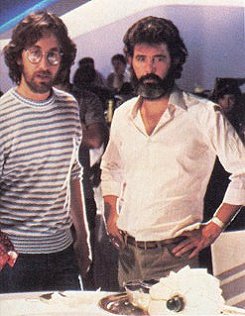
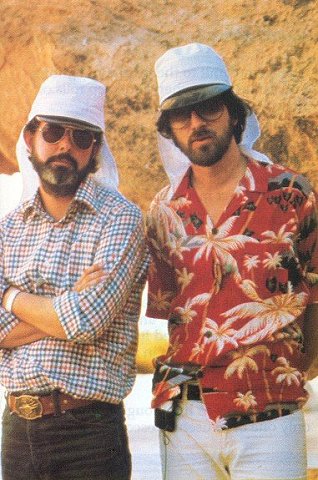
Spielberg and Lucas. |
|
Lucas had presented his idea for
the second film to Spielberg and he had expressed
interest so as in November 1981 he would say to
American Cinematographer:
"I loved the experience of filming Raiders.
I don't know if it was the good fortune I enjoyed
on this particular adventure, but I'm anxious
to work again overseas. I'm definitely going to
direct the sequel to Raiders.
I had such a good time making the first one that
I would hate to let the second one slip through
my fingers into somebody else's hands. I'll certainly
not be involved in the third or fourth one, but
I really want to do the follow up, because the
new story is even more spectacular than Raiders
of the Lost Ark". Still he waited
for a script to sign a contract.
With Lawrence Kasdan unavailable,
since he had begun a career as director, making
his first feature film Body
Heat, Lucas approached his American
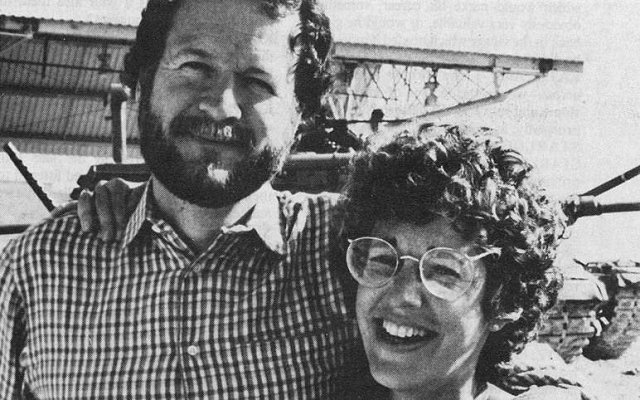
Graffiti co-writers, Gloria Katz and Willard
Huyck in February 1982. He invited the couple
and Spielberg at his ranch for their first meeting
that lasted four days. In the first hour Lucas
described what he had in mind. The title was Indiana
Jones and the Temple of Death and the story
would start in Shanghai, a year before Raiders
and their lost Ark quest. Indy would get into
a situation where his plane crashes. Then he's
asked by a village to help them recover a sacred
stone. That was the basic outline that Lucas had,
and they all started building from there. Lucas
also wanted a child in the movie, a virginal young
princess but the rest of the company didn't feel
comfortable with the idea and came up with a 10-year
old Chinese boy. The idea of the little boy lead
to another idea about a young Maharajah and that
to a story about kidnapped children.
Spielberg thought the title was
too gloomy and proposed the word doom instead
of death, which Lucas accepted. For this second
film they decided to go to the opposite direction
Raiders took,
so appearances from Sallah and Marcus Brody were
dismissed. "The danger in making a sequel",
said Spielberg, "is that you can never satisfy
everyone. If you give people the same movie with
different scenes, they say 'Why weren't you more
original?' But if you give them the same character
in another fantastic adventure, but with a different
tone, you risk disappointing the other half of
the audience who just wanted a carbon copy of
the first film with a different girl and a different
bad guy. So you win and you lose both ways."
Indy's new companion was to be a blond bubble
head who spends most of her time squealing and
complaining. Being the very image of Marion Ravenwood
her only resemblance to that character was that
she becomes entangled in Indy's exploits by circumstances
beyond her control. But throughout the film she
is changed and by its end she's really a different
person.
Since Indy had got his name after
Lucas' dog the writing couple found it funny to
name their new characters after theirs. So they
named Indy's ten-year-old sidekick Short Round
after their fifteen-year-old Sheltie and his new
girl after Spielberg's Cocker Spaniel Willie.
Continuing playing with their characters' names
they named the film's two villains after 17th-century
Indian painters.
Ford was eager to step into Indy's
shoes again and stated to Starlog
magazine: "Of course I'm doing the second
Raiders film.
With great pleasure. Steven Spielberg is going
to direct it. So this is very exciting for me.
It was one of the best working relationship experiences
of my life working with Steven." As time
passed Spielberg was getting involved in other
projects and started making statements like: "More
than likely, I will not direct but closely supervise
it, almost as a co-producer, with George".
Knowing that Spielberg would not wait forever
Lucas took the two writers aside and warned them:
"I'm afraid we might lose him, so you guys
better get this done fast".

Writers
Willard Huyck
and Gloria Katz. |
|
The first draft of the script was
ready after six weeks and Lucas was enthusiastic
from the outcome and so was Spielberg who signed
for the film. "I can see it already",
he said. As Willard Huyck noted in Charles Champlin's
George Lucas: The Creative
Impulse "Steven was amazed, he couldn't
get out of it because we did it so fast".
The script's second draft took another six weeks
while the third was ready after a month. "That
happened over an eight-month period of time",
said Huyck. "We went off to do Best
Defense. Steve would call us continually
to make changes. There were some budgetary restrictions,
and some ideas which came to him as he went to
the locations, things he wanted incorporated into
the script". After some more revisions the
script went to Harrison Ford, who suggested adding
more humor and character refinement in certain
scenes. What Ford did not like was Lucasfilm's
announcement that they were planning a total of
five Indy films. "They must be talking to
Roger Moore then", was Ford's comment. "I
enjoy him very much but it's one at a time for
me". Ford was afraid of being typecast as
an action hero and not a real actor. Besides,
every picture he had starred in had begun to develop
follow-ups and the idea of becoming the 'King
of sequels' wasn't welcomed either.
Since Lucas wanted this film to
be really scary, the villains had to be nothing
like the Nazis or the suave Belloq of Raiders,
so the writers adopted the villains of George
Steven's 1939 version of the Rudyard Kipling poem
Gunga Din, the
Thugs. They were a sub-group among devotees of
Kali, the goddess of Death, and they practiced
ritual strangling - Thuggee - as a form of worship.
Silent and anonymous traveling the roads of India,
murdering travelers and burring them with their
ritual pickaxes; the Thugs kept their sect and
practices secret for centuries. Renaming them
"Thuggees" or, in some versions, "Thuggies",
and marring them with other cultural customs like
Aztec cardiectomy, Hawaiian volcano sacrifice
and European devil worship, Huyck and Katz came
up with what they thought would be the ultimate
villains.
While the villains of the film got
more and more dark Indy's character was coming
more and more light. This time around Indy's motivation
would not be for the sake of archaeology nor for
the artifacts themselves but for the freedom of
enslaved children. This time Indy would show that
he's not just a fortune hunter going after lost
artifacts but a more kind person who cares for
others.
Indy II,
as it was the film's working title, would contain
many violence, human sacrifices, hearts been plucked
out, pointing out that Indy had started shifting
away from thirties nostalgia towards eighties
violence.

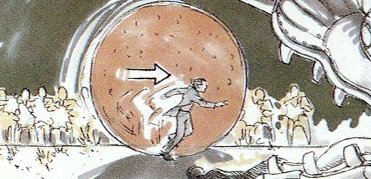
Gong storyboard sketch. |
|
Many of the sequences that were
dropped during the making of Raiders
proved to be valuable for the development of the
new script. Originally Lawrence Kasdan had the
headpiece of the staff of Ra broken up in two
pieces the one obtained by Marion and the other
by General Hok, an evil Chinese warlord settled
in Shanghai. Leaving the United States Indy would
travel to Shanghai and break into Hok's fortress.
There he would face two imposing Samurais. By
shooting one of them and strangling the other
Indy would manage to remain undetected. With one
of the fallen Samurai's sword he would break the
glass cabinet containing the artifact and set
off an alarm system part of which is a ten-diameter
gong. General Hok would enter the place wielding
a machine gun and begin firing indiscriminately.
Indy would manage to unhook the gong and roll
it across the hall using it as a shield. The sheer
weight of the gong would crack the marble flooring
offering Indy an escape. This scene, showing a
more dark character of Indiana Jones, was cut
from script due to cost saving. The new film begins
with Indiana Jones meeting singer Willie Scott
during his negotiations with the Chinese mafia
in a pre-war Chinese nightclub called The Dragon.
Continuing the in-jokes tradition that Raiders
found, the nightclub's name was soon changed into
Obi Wan. Alec Guinness' character from Star
Wars. This scene was also the fulfillment
of George Lucas' past wish to present a tuxedo
wearing Indiana Jones.

Trimotor
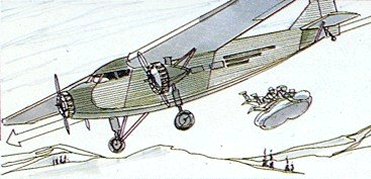
storyboard. |
|
Another scene that didn't make it
from the Raiders
script was Indy's flight to Nepal. On leaving
Shanghai Indy would take a DC-3 to Nepal to find
Marion. On board there would be the usual complement
of passengers: a few tourists, a little old lady,
and some Asians en route home. But it would be
all an elaborate trap and while Indy sleeps everyone
onboard would grab every available parachute and
jump out of the airplane. Indy would wake and
discover the cockpit locked and the plane on a
collision course with a mountain. Pulling out
a rubber life raft, he would wrap it around his
body, leap from the plane, pull the inflate cord
in midair and land safely on the snowy Himalayan
peaks. Using the raft as a sled Indy would ride
down the slopes all the way to Marion's bar. The
scene was incorporated in Indy
II following Indiana's escape from Shanghai
and was modified in mid-production at Spielberg's
request, transforming the script's passenger plane
into a cargo craft and adding a clutch of chickens
to the payload.

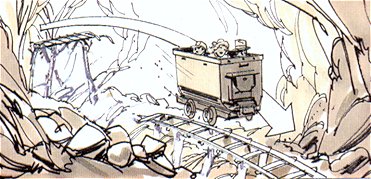
Mine-cart storyboard. |
|
A third scene cut from Raiders
was in the film's climax. After Belloq's death
Indy and Marion load the Ark on a mine car and
try to find a way out, as the whole place is set
ablaze. What follows is a wild chase in the dark
mine tunnels as they are pursued by a group of
Nazis. The race between the cars seems unfair
since our heroes' car does not work properly.
In the nick of time the car's throttle works and
it accelerates its speed rapidly, leaving the
Nazis engulfed by flames. Reaching the rail's
end the couple finds a small Nazi transport launch
carefully disguised as a Greek fishing boat. In
the next shot the boat is chugging out to sea
as the island rumbles and shakes. For this new
film the concept of the mine car was considered
first as a small scene only to become one of the
film's greatest set pieces.
Next: Scouting
for Locations and New Faces >>
|