Robert Watts, who
was associate producer on Raiders,
would be producing the film while Frank Marshal
would share executive producer credits with George
Lucas. Watts would be basically responsible for
organizing the whole of the movie's shooting,
plus jointly with Marshall, seeing it through
post-production.
Ever since the film's body structure
had been finalized location scouting got underway
while Paramount
agreed to give a $28 million budget, sure that
this time they were betting on a winner. Negotiations
had been opened with the Chinese government to
film scenes like a motorcycle chase along the
Great Wall and the discovery of dinosaurs in a
lost valley. However, the Chinese refused permission
to film on the Wall, and inflated the prices for
everything else needed to make the film.

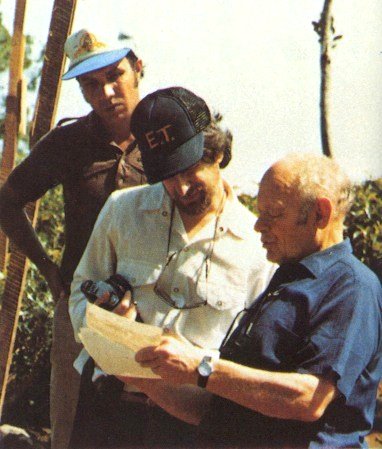
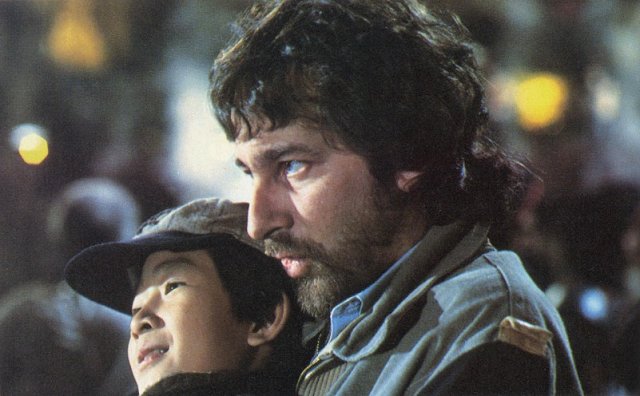
Producer Robert Watts. |
|
Watts brought onboard Elliot Scott
as production designer and together they went
to India and spent several weeks scouting the
country for locations. There they found every
location called for in India with the exception
of a gorge they needed for the film's climax.
Watts and Scott thought about looking in the Himalayas
in the north of India, but the area was likely
to be covered in snow during their preparation
period. And that wasn't the only problem. Although
they had found most of the desired locations they
were so far away the one from the other that made
filming logistical wise forbidding. Sri Lanka
with its exquisite jungle foliage and picturesque
terrain was ideal for Indiana's new adventure.
When they scouted in Sri Lanka, they find the
gorge in a place where their other location needs
would be accessible from their base of operations,
which was Kandy, the second principal city after
Colombo, the capital. "We found the gorge
by helicopter, and we were extremely fortunate
that there was a dam under construction right
behind it," said Watts. "A British company,
Balfour Beatty Nuttall,
was constructing a major dam for the Sri Lanka
government, a gift from the British government.
They didn't do it for nothing but it was certainly
much cheaper than if we would have to import engineers
and equipment. And there were access roads and
all the things that go with having a building
site on hand. They strung the bridge across the
gorge, so we were confident that it was structurally
sound and they gave us the number of people we
could put on it, which was twenty, and we kept
it below that figure, so it was perfectly safe."
Still, for interior shots Watts
hoped to film many scenes in the Rose Palace of
Jaipur in the Indian state of Rajasthan, but the
local government, scandalized by the script's
horror-comic character, demanded so many changes
that he and Lucas decided Elstree's
soundstages would be just fine.
Douglas Slocombe, one of the many
who worked on Raiders
and returned for Indy's new adventure said about
his relationship with Spielberg, "The wonderful
thing about working with Steven is that he plans
everything very, very carefully in advance. He
starts off by doing rough sketches, little drawings
of the visuals, which are eventually finalized
by professional artists. Of course, he adapts
certain shots on the day, but the important thing
is that everyone has had a pretty good idea weeks
and months in advance of what he intends to portray.
This helps one enormously in planning what equipment
will be needed and what conditions one is likely
to encounter."

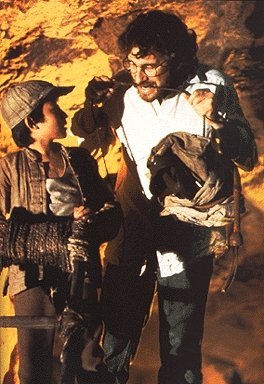
Elliot talking to Steven. |
|
Elliot Scott had never before worked
with Spielberg and that proved a revelation to
him, "I've never worked with a director like
Steven Spielberg before. He plans and plans and
plans. He's not a hard man at all, in fact he's
rather pleasant, but his sheer enthusiasm just
carries you forward. He uses sketches to map out
virtually the entire film, forcing himself to
consider all the options at the drawing board
stage. These are very rough sketches visually,
but there's a lot of depth in them, a lot of information.
He would have sketch artists adapt his roughs
and send them over to me saying: 'This is the
way I want the action to go.' Then I would try
to adapt the sequence to fit the set. Prior to
that I would have shown him a model of the set
so he knows in general where things are, but using
these action sketches he would find that he needed,
say, another camera or another doorway or another
this or that. He would ask us to adapt the plans
of the set, make something longer, shorter…
all at the drawing board stage, which saves considerable
amounts of money in the long run and allows everyone
involved to know where they are going."
Anthony Powell was assigned with
costume design duties. He's previous work included,
among other films, Dragonslayer
and Evil Under the Sun.
Powell, who had spent 25 years visiting museums
and building his own research library, found himself
in a great deal of research. While researching
pre-war China for the scenes in Macao, Elliot
Scott, the Production Designer, showed Powell
a Carrier Bresson book of photographs from 1937.
In that book Powell spotted a photograph of a
little Chinese boy wearing baseball shoes and
immediately thought of Short Round. Steven loved
it and said: "Let's give him an American
baseball cap, which he's gotten from one of the
tourists." In the Bresson book Powell also
found photographs of Chinese and European refugees
at the airport. The real life refugees were dressed
in ways one could never invent. Priests wearing
pith helmets and carrying tennis rackets. Chinese
people wearing absolutely conventional European
suits but with the most bizarre Chinese hats on
their heads. Again, Powell showed them to Steven
and they ended up putting a huge crowd of missionaries
into the airport scene. Of course Powell could
not avoid getting involved with Indy's wardrobe
and its problems. "We couldn't use the original
costumes because they had been virtually destroyed.
To the public, Indy wears an old shirt and an
old pair of pants, but they don't realize how
much is involved and how expensive it all is.
For a start, you need six of everything because
what clothes have to go though on an action picture
is phenomenal. Every time Harrison falls down
a ravine or jumps in a river, he will need a change
of costume. There are also stunt men and doubles
that have the same requirements. On this movie
alone, we needed about thirty shirts for Harrison,
and it doesn't show on the screen at all. Continuity
is another problem. Films aren't shot from the
beginning to the end. Quite often, shooting starts
at the end of the script and works backwards.
This poses special problems on clothing. By the
end of the movie, Harrison's costume has to look
like he's crawled through jungles, fallen down
mines and fought his way to hell and back. Now
to make clothes look like as if they're in that
condition and as if someone has been wearing them
for ten years involves, say Grand ball gown. The
cost of aging clothes artificially can be much
more than the cost of making them in the first
place. There are a million tricks of the trade
involved: staining, bleaching, washing, dyeing,
sandpapering. It's very hard work! There is. Even
for a movie, which isn't based in reality, like
Indiana Jones and the
Temple of Doom, it's always worthwhile
doing careful research beforehand. Truth really
can be stranger than fiction."
  
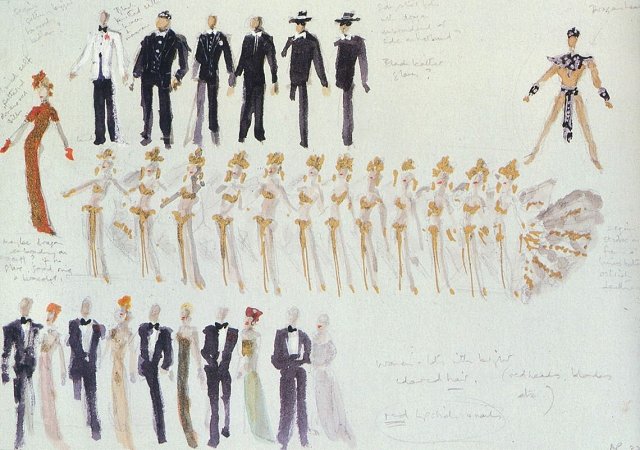
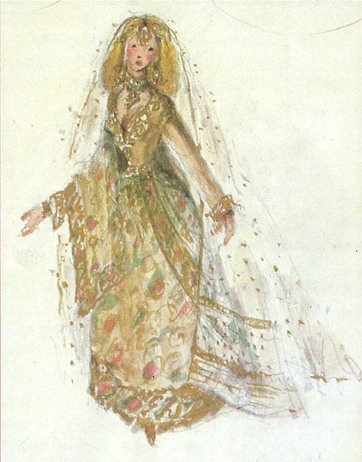
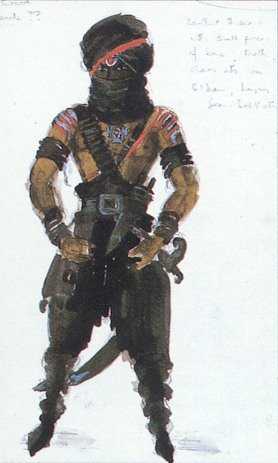
Original costume
drawings by Anthony Powell. |
  
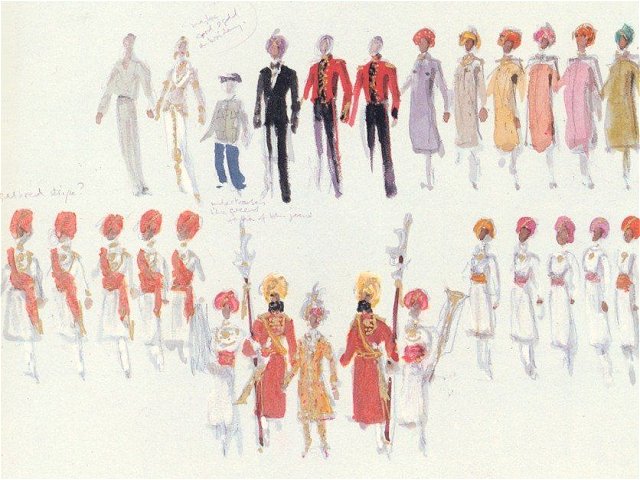
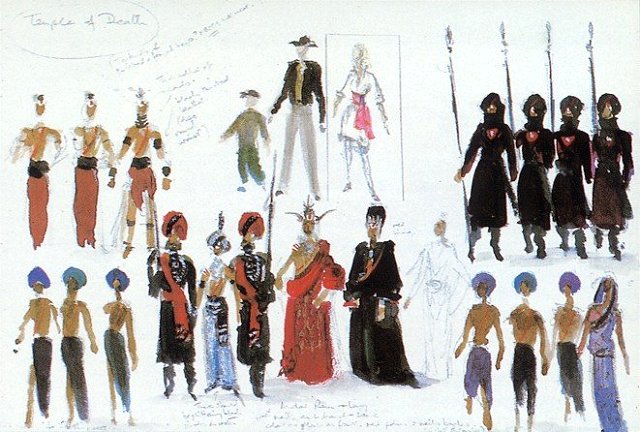
More Temple
of Doom costume
drawings by Powel. |
"I like to make my original
costume drawing not too specific." Anthony
Powel said. "As long as the drawing gives
the director and actor idea of what they're going
to get, that's sufficient. The real work comes
in the fitting room. It seems to me that unlike
theater, where an actor can transform himself
and be totally convincing, cinema is a different
medium. The camera sees through artifice. The
most interesting and successful screen actors
have been those who have traded on their own personalities,
presenting different aspects of themselves in
various movies. What I feel I have to do is take
what is actually there in an actor, not just physically
but in the quality of personality, and take the
character in the script as it's written and bring
these two together halfway. One may have worked
something out very carefully on paper, but the
important moment is in the fitting room. Clothes
have to look absolutely right for that person.
You have to strive for something that looks inevitable,
that looks as if it has been airbrushed on the
person. All of that happens in the fitting room,
not in preliminary drawings."

Mola Ram's headdress. |
|
Tom Smith, the film's make-up artist,
was also responsible for creating costumes and
props out of Powell's designs. "The headdress
for Mola Ram, the Thuggee high Priest, was an
interesting challenge. I was shown drawings of
it by the costume designer. They were scouring
all over the place trying to locate real horns,
which weight a ton, and the whole design was becoming
difficult to manage. Especially as the actor would
arrive at 7 am and had to be ready on the set
by 8.30 every day. I set about simplifying the
whole thing and did four clay mock-ups of the
shrunken head that's fastened to it. The headdress
was like the skull of an animal, based on a steer's
head, and I used bony formation, rather than horns,
which also as an anchor for the hair of the shrunken
head. We actually plugged the hair in with a needle,
directly into the latex, to create the effect
of correct density in such a small area."
With the script in revision state
and the film in heavy pre-production mode auditions
for the actors who would portray the new characters
in the Indiana Jones saga begun.
More than 1000 actresses, including
East Coast soap opera stars and one Noxzema girl
auditioned for the role of Willie Scott. Among
the totally unknown actresses auditioning for
the role was one named Sharon Stone. Although
she was among the top three choices she didn't
take the part; instead, she went on to co-star
in the remake of King
Solomon's Mines, opposite Richard Chamberlain,
in a role similar to the one she lost. Finally,
Spielberg chose a green-eyed Texan girl called
Kate Capshaw after viewing her videotaped test.

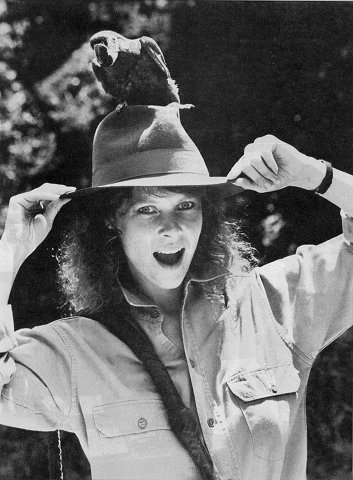
Kate wearing a fedora. |
|
Born Kathy Sue Nail, she had graduated
from the University of Missouri with a master's
degree in learning disabilities, and taught school
for two years before she realized she wasn't happy
with what she was doing. Following the birth of
her daughter Jessica, she decided to pursue a
career in show business. Starting as a model for
the Ford agency in New York, she appeared in many
TV commercials, then moved to soap operas like
Edge of Night,
and in 1982 made her first feature film called
A Little Sex,
playing opposite Tim Mathison. Capshaw's then-agent
happened to be a jogger and one of his jogging
partners was the casting director of Indy
II. It was then when she decided to audition
for the part. She wasn't unfamiliar with the character
of Indiana Jones. "I was living in Hollywood,
and one night, my boyfriend and his friend wanted
to take my girlfriend and me to see Raiders of
the Lost Ark. I told them that they should go
and we would do something together while they
were in the theater, but he was very persistent.
I went, very petulant and sulky, and stayed that
way for about two minutes after the movie started,"
she relates laughing. "When I came out, if
there had been anyone doing interviews, I would
have been a great advertisement for going to see
that movie!" Nothing could predict that some
years later she would become part of the cinematic
legend. Learning that she had won the role came
to a surprise to her. "Steven called me and
told me I got the part. Maybe I was expecting
fireworks and bombs but I just laughed. I thought
he was kidding!"

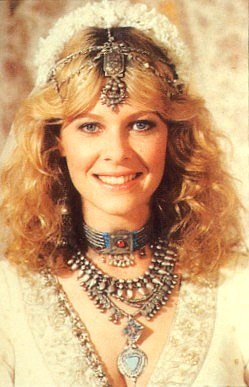
Kate as Willie Scott. |
|
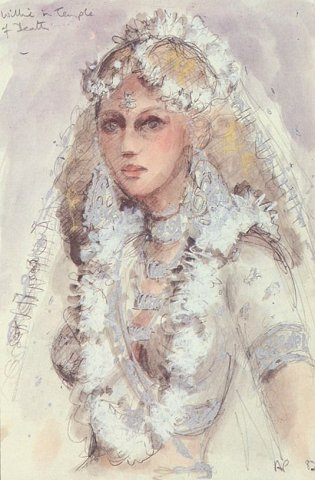
Capshaw loved the character of Willie
Scott from the start and she was looking forward
to bring it to life. "Willie has led this
pampered life and feels that's what's due her
- to be cared for and looked after. She meets
Indiana Jones, a person unlike anyone she has
ever been involved with, and ends up going off
with him. In the course of all their adventures,
all of her earlier life is stripped away from
her, and Willie must fall back on her own resources.
She discovers that she is a very strong woman,
a gutsy lady. Willie is a much different character
than the woman Karen Allen played in Raiders."
To convey the 1930s leading lady image Capshaw
had her hair bleached under Spielberg's advice.

Quan as Short Round. |
|
Finding a child actor to play Indy's
10-year-old sidekick proved much harder than finding
the female partner for the daring archaeologist.
Spielberg asked casting director Mike Fenton to
arrange open calls in several major cities, New
York, San Francisco, Los Angeles, Hawaii, Toronto,
Chicago, Montreal, Hong Kong and London. Open
call means that anybody, professional or complete
amateur, can walk in off the street and be interviewed
on videotape. In total they held something like
eight open calls and looked at almost six thousand
young boys. On a Saturday morning of February
1983 while Spielberg was visiting LA's Chinatown
schools he discovered a little Vietnamese boy
called Ke Huy Quan. Quan was born in Saigon and
his father ran a plastics business. In 1976 Quan,
with his parents, six sisters and two brothers
fled Vietnam as one of the "boat people",
as the press called them. The Quan family seeked
refuge in Hong Kong and stayed there until they
were accepted by the U.S. Government for resettlement,
in 1980. Due to his lack of film background Quan
treated the whole process of auditioning like
a game. Even when he was asked to screen test
opposite Harrison Ford. "He wasn't intimidated
by the fact that Lucas, Spielberg and Ford were
in the same room with him", relates Watts.
And that was true, since he had never seen Raiders
he was unfamiliar with the character of Indiana
Jones and the men who created him. "I had
heard of Han Solo before but I didn't know his
real name was Harrison Ford," replied innocently
the young actor.
  
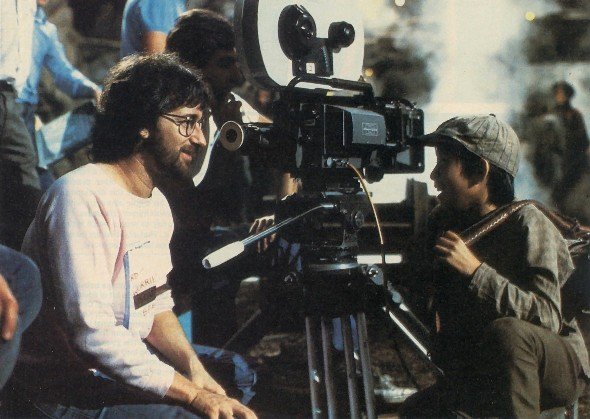
Ke Huy Quan and Steven
Spielberg between takes. |
Quan although spoke English very
well, he couldn't read. So Spielberg decided to
go with improvisation. He explained to Quan a
scene he had just made up: he would play cards
with Ford and he would realize that he had been
cheated. "When he pulls a fifth ace and he
takes your money and he's a cheater, you don't
let him go away with that. You have to win that
card game," was Spielberg's only directions.
Ford and Quan played the scene and it was so good
they decided to keep it in the film. Once he was
chosen, the youngster had to watch Raiders
to know what the first one looked like, so Spielberg
arranged a private screening for him.
Watts had assumed that they would
get a Chinese kid who, because he lived in the
States, would sound like an American - or had
they found one in London, like a cockney or something
and so he had reckoned and budgeted for a dialogue
coach since he expected that the boy would have
to be coached to achieve a Chinese accent. "We
roamed the globe looking for this kid and what
happens? He turns up in our own back yard,"
he said laughing.
At the time of the casting for the
supporting actors Spielberg had moved to the St.
James Club, a private hotel south of Piccadilly,
which became his base of operation. Spielberg
took there miniatures of the major sets, the crusher
room, the temple and the mine cave built by Scott
along with four thousand storyboards, drawn by
Ed Verraux, Joe Johnston and Elliot Scott, and
he spent five months studying them in order to
find the angles he wanted to photograph.

Mr. Puri as Mola Ram. |
|
For the role of Mola Ram, the arch-villain,
they searched through England and the United States
to find someone to play the part-both Lucas and
Spielberg were most anxious that they did not
cast the principal Indian roles with Western actors
darkened down. They wanted real Indians. They
couldn't find anybody amongst the resident Indian
actors in the United States, and so they got a
permit for Amrish Puri, one of India's top actors,
to go and do the film. Puri was working on 18
films in India simultaneously at the time of his
casting. "This was something I had never
before come up against," commented Watts.
"The Indian film industry operates in a manner
that would drive me stark raving mad. The actors
work sometimes two or even three shifts a day,
four-hour shift. And they may work on two or three
different films; they'll be in one in the morning
and another in the afternoon. In the end, we had
four different visits from Amrish (one in Sri
Lanka, three in London). He had to juggle around
all his Indian commitments to do this movie. It
wasn't easy."
Veteran Indian actor Rosan Seth
was given the role of oily prime minister of the
Pankot Palace, while David Yip, known in Britain
by the TV series The
Chinese Detective, would play Wu Han, an
ill-fated ally of Indy in the opening night club
scene.
Ford was pushing 41 and since Indy
II was a prequel to Raiders
his character was younger, so Spielberg advised
him to get in shape and spent eight months in
training and muscle building under the supervision
of Jake "Body by Jake" Steinfield right
after completing his work on Return
of the Jedi. "I don't know why they
did that to me. I got three years older and the
character got one year younger. So I'm four years
older than the character. And I can feel the difference,"
Ford stated in wonder. Steinfield specialized
in training entertainment personnel and worked
with Harrison Ford before and during the movie,
keeping him in shape. He was also working out
Steven every day. Jake used to double for the
Incredible Hulk.
When they traveled to Kandy they found there an
old YMCA, so he and Ford would go down there to
work out two or three times a week. It was the
most primitive weight room anyone ever saw, with
very old weight and ancient benches.
Filming was to begin in April 1983,
because Spielberg wanted to attend the Academy
Awards ceremony since E.T..
was nominated for 10 Academy Awards.
Next: On
location in Sri Lanka >>
|