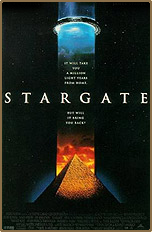
Before Dean Devlin and Roland
Emmerich made the rather embarrassing Independence
Day, and well before they released the
utterly laughable and shameless Godzilla,
these two filmmakers made a good movie. Yes, a
good movie called Stargate.
In the summer of its release it was competing
with a powerhouse franchise, Star
Trek, whose seventh film, Generations,
was also in theaters. Stargate
held its own that summer and did quite well. It
has since spawned its own television series and
a small following of fans. To movie enthusiasts,
Dean Devlin's claim to being one of the first
ten people in line to see Star
Wars in 1977 well known. Therefore, it
is no surprise that Stargate
has many elements that are reminiscent of George
Lucas' other famous series, Indiana Jones.

Excavation
at Giza. |
|
The plot is simple, but intriguing.
In the year 8000 B.C. in the deserts of Egypt,
a massive spaceship lands one night and its alien
pilot enslaves the natives. In 1928, during an
archaeological excavation at Giza, a group of
Swedish diggers discover a massive metal ring
with unknown glyphs on its surface. Now in the
present day, a fringe Egyptologist and linguist
named Daniel (played by James Spader) believes
that the pyramids are much older than assumed
and not tombs as traditionally supposed by scholars.
Out of the blue, a woman comes to him and tells
him that she wants him to translate some ancient
hieroglyphs for her.
She takes him to an underground
facility where she shows him a huge circle of
stone tablets, each with known and unknown glyphs.
He translates them and learns that the stones
speak of the burial of a dangerous "stargate".
Daniel also discovers that the unknown glyphs
are actually constellations that point to coordinates
on the other side of the universe. The woman shows
him the actual stargate, the metal ring unearthed
seventy years before. Using his knowledge of the
glyphs, Daniel manages to activate the stargate
and open a portal to an unknown world across the
universe.

Daniel's first
contact with
the active stargate. |
|
Led by Colonel Jack O'Neil (played
by Kurt Russell) a team of soldiers and Daniel
enter the portal and arrive on a desert world
with no way home, as the opposite stargate's glyphs
are different. Daniel knows the only way home
is to find someone or something that has these
inscriptions. They find an exact duplicate of
the Great Pyramid on the planet and they meet
a community of natives who worship them as gods.
At the same time, a massive ship descends from
space, landing atop the pyramid. Daniel and Jack
learn that the alien who commands the ship and
the people on the planet is Ra, the Egyptian god
of myth now revealed as a malevolent alien being,
once ruler of Egypt, and using humans as a means
of immortality.
While Daniel frantically tries to find the right
glyphs to activate the stargate, Jack learns that
the nuclear device he was ordered to use in the
event that the alien world was a threat to Earth
has been taken by Ra. The evil alien intends to
send it back through the stargate one hundred
times more potent and destroy those that rebelled
against him so long ago.

Assault
on Colonel
O'Neil's team. |
|
This film is easily the most intelligent
and thought-provoking film that Devlin and Emmerich
have concocted. The ideas of the story that the
pyramids are not actually tombs and may have been
the work of aliens or lost civilizations, are
very much in the vein of Indiana Jones. More specifically,
it is clear that the filmmakers were highly influenced
by the theories of scholar Graham Hancock, who
has argued for years that there is evidence, which
suggests that the pyramids are much older and
more complicated than traditional Egyptologists
claim. Ironically, Graham Hancock's own pursuits
were heavily influenced by Indiana Jones, as he
admits in his book, The
Sign and the Seal, which documents his
quest for the Ark of the Covenant after seeing
Raiders of the Lost Ark.
The plot of Stargate
focuses more specifically on the theories that
Hancock expresses in his other comprehensive study,
Fingerprints of the Gods.

Horus-like alien
soldier. |
|
While the film takes these ideas
to extreme levels, with aliens and other planets
involved, the essence of the script is very much
in the realm of Indiana Jones. The opening scenes
of Spader translating the ancient writing to discover
the deep implications of its contents feels very
much like Indy translating Donovan's tablet in
Indiana Jones and the
Last Crusade. The desert landscapes and
the dark cavernous temples and tunnels with ancient
glyphs all have a Raiders
of the Lost Ark quality about them. In
the 1928 dig scene, watch carefully and see how
the platforms the actors traverse to see the site
are identical to the platforms the Germans use
at the Tanis dig site as well as the way the camera
dollies through the chaos of the endeavor.
It is these elements of Stargate
that make it a compelling film. Yes, it is fun
to watch Kurt Russell fight off huge Horus-like
soldiers with laser blasters and see the swirling
effects of the stargate itself, but the foundation
of the film is the most fascinating element. Indiana
Jones fans will find a lot to enjoy in this story.
For those who have superhuman eyes,
John Rhys-Davies who played Sallah in Raiders
of the Lost Ark and Indiana
Jones and the Last Crusade supposedly has
an unbilled cameo in the beginning of
Stargate as a "Shouting Digger"
from the 1928 dig scene. This is according to
the
Internet Movie Database, so see if you can
spot him next time you watch the film. Also of
note in the film is the cameo by Kit West, who
is famous for working on the visual effects in
the Indiana Jones films as well as Stargate.
He can be seen in the opening of the film during
Spader's lecture scene playing one of the skeptical
scholars. (MF) |