The famous tale of King
Solomon's Mines and its hero Allan
Quatermain is to filmmaking what the writings
of William Shakespeare are to the theatre. Nineteenth
century writer H. Rider Haggard painted a story
that continues to inspire the imaginations of
filmmakers. Like the countless versions of Hamlet,
every incarnation of King
Solomon's Mines contains new ideas
and interesting interpretations.
The original black and white adaptation,
made in 1937, was a tale of high adventure as
only the golden age of Hollywood could tell it,
in the style of its contemporaries such as Gunga
Din. Those kinds of grand adventure films
are capsules of their time and sadly, can never
be replicated, nor their spirit completely recaptured.
The 1950 adaptation of King
Solomon's Mines is a Technicolor classic
of epic scope, dignified performances, and thought-provoking
dialogue. The film is a perfect balance between
an adventure-filled fiction and an anthropological
documentary. To date, it is the most critically
acclaimed adaptation.
The version
starring Richard Chamberlain in 1985 is a vapid
satire, a film for pop-culture popcorn stuffers
that abandons the essence of Haggard's story
in favor of cheaply echoing Indiana Jones to exploit
its then recent success.

Swayze
as Quatermain. |
|
Nineteen years passed before
Allan Quatermain was seen on screen again. This
time, he came to television, in an epic-length
miniseries. Hallmark
Entertainment adapted
King Solomon's
Mines for their cable
channel in 2004.
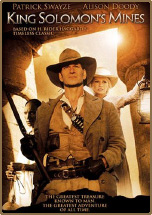
This version stars Patrick Swayze as the great
white hunter Allan Quatermain. Playing Elizabeth,
Quatermain's female employer, is Alison
Doody, whom all Indiana Jones fans know best as
Elsa from Indiana
Jones and the Last Crusade.
She is the second Indiana Jones alum to appear
in an adaptation of King
Solomon's Mines,
succeeding John Rhys-Davies, who appeared in the
1985 version.
Quatermain's first foray into television
results in an impressive accomplishment that easily
stands equal with the acclaimed 1950 version and
thankfully does much to erase the memory of the
1985 adaptation. At just under three hours in
length, this version is the longest of them all,
and it fills that space with great material.

Exploring Africa.
|
|
Once again, Quatermain is
hired by a young woman to help her find her father,
who has been lost in the unexplored wilds of Africa.
From the outset, this is a much more character
driven adaptation than the previous versions.
The biggest character exploration in this version
is Quatermain, whom in the other versions is either
a stalwart icon of experience and strength or
a shallow, adventuring cad. Quatermain's
difficulties in dealing with the death of his
wife and regaining custody of his son are subplots
that give the great white hunter an added dimension
in this version. Swayze brings the character to
life with believable humility and dignity in a
solid performance.
Doody is equally up to the challenge of effectively
reinventing the Elizabeth character. Still a very
feminine presence in the story, Doody plays a
determined and intelligent, but inexperienced
woman without the overt and stereotypical weakness
of the Deborah Kerr version or the screaming lunacy
of the Sharon Stone incarnation. Doody brings
out Elizabeth's love for her father quite
effectively in a way not seen before.
Quatermain's companions are equally developed
instead of being mere pack bearers. The tribesmen
and the villains encountered along their journey
are also real characters rather than figureheads
and human props.
This version is more accessible
to a modern audience, utilizing a modern sense
of action, pacing, and editing. At the same time,
it is the version that Indiana Jones fans can
really sink their teeth into. Never before has
Elizabeth's map been an object of such importance,
and here it is given a priority akin to the headpiece
of the Staff of Ra in Raiders
of the Lost Ark.

Entering
a tomb. |
|
In the film, aside from the
obligatory but well-executed chases, escapes,
and gunfights, there are two sequences that scream
echoes of Indiana Jones. In the middle of the
film, our heroes locate a tomb in the desert that
supposedly holds a key that they need to eventually
enter Solomon's fabled mines. They enter
the underground tomb by torchlight and Quatermain
and Elizabeth approach a sealed, stone coffin
in a shot composed in a very similar fashion to
Indy and Elsa at the knight's tomb in Venice.
Quatermain and Elizabeth proceed to push the lid
away together, Swazye on the left and Doody on
the right, just like Indy and Elsa. At the same
time, Elizabeth proceeds to blow away the sand
on the lid to read the hieroglyphs and carvings,
just as Elsa does in the knight's tomb.
At this point in the film, I could not help but
wonder, "Was Doody remembering Last
Crusade while filming
this? She must have been, and probably wondering
how many times in her career she would have to
blow dust off tombs and push the lids open."
Soon after, Doody is held hostage with a gun to
her neck, in a scene that immediately conjured
up the image of Vogel with his Luger pressed against
Elsa's neck in Indiana
Jones and the Last Crusade.
The satisfying difference between Quatermain and
Indy in this situation was twofold.
For one, Doody's Elizabeth is not Elsa and
does not betray Quatermain as Elsa did to Indy.
Secondly, regardless of Elizabeth's loyalty,
Quatermain only feigns lowering his rifle and
quickly brings it to bear again with no intention
of taking his eyes or his aim off his enemy. In
this moment, Quatermain makes Indy look like a
chump.
At the climax of the film, Quatermain
and Elizabeth enter the legendary mines and encounter
a chamber of booby traps that are reminiscent
of the chamber in which Indy sees the idol in
Raiders of the Lost Ark.
Instead of darts coming out of the walls, Quatermain
must deal with spears shooting up through the
floor.
When Quatermain and Elizabeth enter the inner
treasure chamber, there is another moment in which
Doody must have been flashing back to Indiana
Jones and the Last Crusade. When trying
to decide whether or not to reach for a significant
gem in the chamber, Quatermain looks at Elizabeth
and says, "There's only one way to
find out."
This is the second time that line has been delivered
to Doody under such circumstances. The first time
was when Indy and Elsa stand together in the Grail
chamber and Indy steels himself to drink from
the wooden cup, saying the exact same thing before
taking his fateful swig.

Alison Doody's
return
to adventure. |
|
After a rousing escape from
the collapsing mine, Quatermain and Elizabeth
retreat to safety, and I was left to reflect on
not only how fun the film was to watch, but what
an effect Alison Doody's presence in the
film had on my viewing experience as an Indiana
Jones fan.
Even though I knew that Elizabeth is traditionally,
and likely forever will be, a true character and
companion in the Haggard story, I was continually
thinking to myself, "Keep an eye on her,
Quatermain. She might betray you!" and, "Is
she actually going to make it out of the mine
alive or fall into a bottomless pit and perish?"
Keep in mind, Alison Doody's performance
of Elizabeth is nothing like Elsa and she is a
treat to see on screen again, but Indiana Jones
fans like this writer will look at her with an
added dimension and have fun speculating.
The latest incarnation of King
Solomon's Mines is a great achievement
both as an adaptation and an adventure in its
own right. Finally, there is a worthy successor
to the Stewart Granger picture that brings Allan
Quatermain's grand adventure into modern
cinema. Check this one out if you are an Indiana
Jones fan. (MF) |