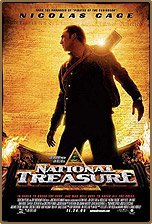
Over the years, the adventure
film has been a cinematic mainstay. Musicals and
Westerns had their day and faded. Gangster flicks
and disaster films come in small waves and disappear
just as quickly. The action film of the 1990s
is still limping into the early 21st Century,
but it's a wheezing genre born from a trivial
decade. The writer has no doubt that it will soon
go the way of the beach party films of the 1950s.

Stealing
the Declaration
of Independence. |
|
The adventure film however,
has endured and with every decade finds new life
and reinvention. Sure, there was a brief lull
in the 1970s, but the genre was resurrected with
flare in 1981 with Raiders
of the Lost Ark.
The adventure genre began in the silent films
of Douglas Fairbanks, as he swashbuckled his way
to rescue the princess and stop the evil tyrant
in movies like The
Black Pirate. Films
like Gunga Din and
King Solomon's
Mines (which has been made into a movie four
times) kept the adventure genre alive before the
coming of Indiana Jones.
In the post-Indy decades, the adventure film has
evolved beyond its serial, swashbuckling roots.
The evolution has not been in the characters or
in the quests, but the complexity of the plot,
the technology, and the puzzles the heroes must
solve. Some argue that this complexity is necessary
due to a more sophisticated audience living in
the now.

Deciphering
a message. |
|
This writer disagrees with
that assessment. Why? The box office receipts
from The Fast
and the Furious have
concretely concluded that audiences are not more
sophisticated now than before. Still, at least
films like National
Treasure come into theatres
to give the tepid cineplexes a breath of fresh,
intelligent air.
This critic was extremely surprised that the film
turned out to be as intelligent and well plotted
as it was, given that it was another Jerry Bruckheimer
vehicle. After Pearl
Harbor, anyone would
be doubtful of this producer's work.
The film follows the adventure of Ben Gates and
his trusty techno-whiz sidekick Riley as they
race to find the lost treasure of the Knights
Templar before malignant forces get there first.

Hidden
messages on
the Dollar bill. |
|
In the classic traditions of Indiana
Jones and his predecessors, Ben Gates looks in
dusty books, wrinkled maps, faces the possibility
of century-old conspiracies, and confronts the
dangers left for him in ancient tombs by long-dead
societies. With the help of Riley and the female
ingénue Abigail Chase (a name probably
ripped right out of the Indy-inspired Danger
Girl comics), Gates follows the ancient clues,
deciphers cryptic riddles, jets around the country
to mysterious locales, breaks into tombs under
churches, and opens secret doors with ancient
keys.
Take out Ben Gates' name and it's
exactly like Indiana Jones, right? Correct. That's
what makes this film great, with the only exception
being the increased complexity of the puzzles
and riddles, the sheer number of them, and of
course the added technology of cell phones, computers,
and all manner of sensors and devices.

Exploring a
tomb. |
|
To give any plot details is
to give away the fun of the film, but Indy fans
will enjoy the inclusion of Gates' relationship
with his father and the antagonistic relationship
with Abigail as well as the dry humor of Riley.
Gates deviates from Indy in one respect. Unlike
Indy, Gates believes in what he is searching for
from the first second of the film to the last.
There is no disbelief in the treasure whereas
Indy doubted the existence of the Grail or the
magic of the Sankara Stones.
The action is great, the pacing
is superb, and even if the ending is a little
rushed, so be it. From the first frame to the
last frame, it's intelligent, witty, and
inspired. Enjoy it Indy fans. (MF) |