| Shooting
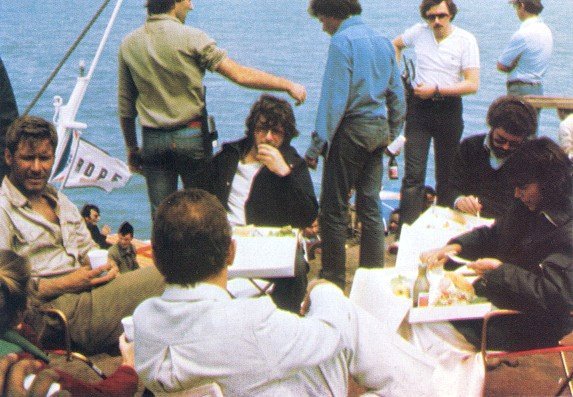
began on June 23, 1980, in the
historic French resort of La
Rochelle, located 100 miles
north of Bordeaux. Robert Watts
had found there a World War
II German submarine built for
a German film, Wolfgang Petersen's
Das
Boot. The contract that
the producers had made with
the Germans who owned the submarine
said that they couldn't take
the sub out to sea if the waters
were more than a meter high.
They sent an engineer from Munich
who had built the submarine
because Watts insisted that
they have somebody who had the
authority to say that they could
or couldn't go. The submarine
was lying in a former Nazi sub
pen that had been built during
World War II. The submarine
pens, which proved invaluable
to the production, were huge
caverns built to house six submarines
each. Despite the many direct
hits scored by Allied bombers,
evidenced by pockmarked craters
on their exteriors, these pens
continue to stand as poignant
reminders of World War II. Consisting
of 12-foot-thick walls and two
six-foot-thick roofs, the pen
used by the production had a
stark, gray interior. The visual
impact of the pen was further
enhanced by a rocklike sea entrance
constructed by the art department.
The interior of the submarine
pen was also perfect for the
Nazi base sequence. It was a
bona-fide German construction
that had even German writing
on it from the war. Before filming
began in La Rochelle, the production
faced the challenge of finding
a 1930s-era tramp steamer to
serve as the Bantu Wind, Indiana
Jones and Marion's pirate ship
that would take them to London
with the Ark. An original coal-fired
version was not to be found.
A replica that had been constructed
at the Bavaria Studios in Munich
wasn't deemed seaworthy. Fortunately,
an adaptable Egyptian vessel
was spotted in an Irish port,
commissioned for a month, refitted
by the art department and sailed
to the French coast.
 
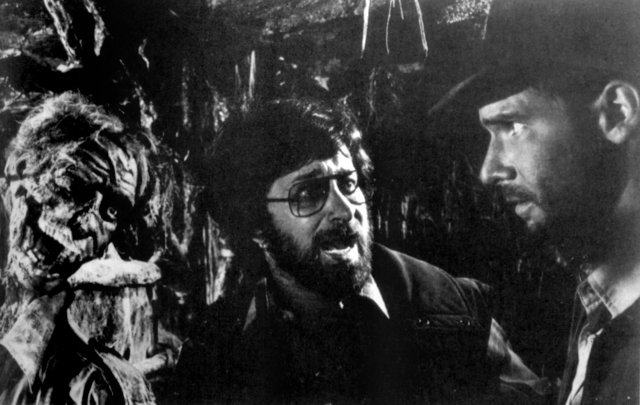
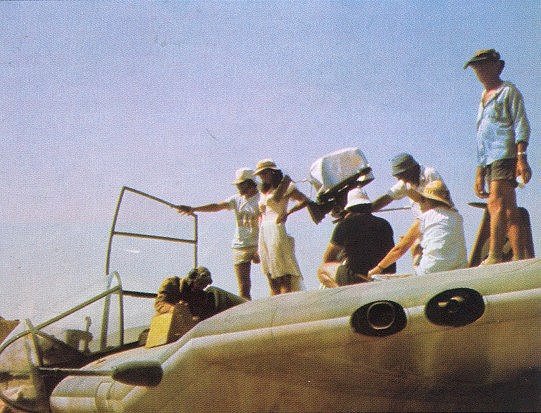
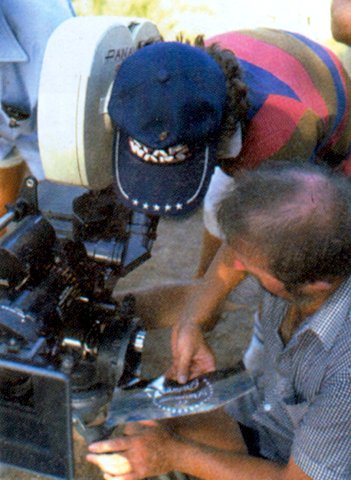
Ford
and Spielberg preparing
a scene on the Bantu Wind
boat. |
The first day
the production team arrived
it was raining and the Atlantic
seemed uninvited. It was impossible
to film anything. Same happened
and the second day. The third
day the sea had calmed down
and they managed to shoot through
all day. Each morning, for as
long filming lasted, everyone
was ferried out to the tramp
steamer that had anchored in
open water three miles from
the coast and transferred across
a heaving four-foot gap between
vessels.
With all the scenes
from the ships and the dock
bay shot, the production moved
at Elstree.
There, on June 30, the first
day of interior filming, was
spent at Imam's house, the astronomer-priest-scholar
who helps Indy find the Ark
by translating the inscription
on the medallion. He lives in
a house on a rise at the edge
of Cairo. The house is exotic
and romantic, enchantingly furnished
in traditional Casablanca
mood, with an enormous revolving
fan on the ceiling and a hole
on wall that provided a wonderful
site of evening Cairo.
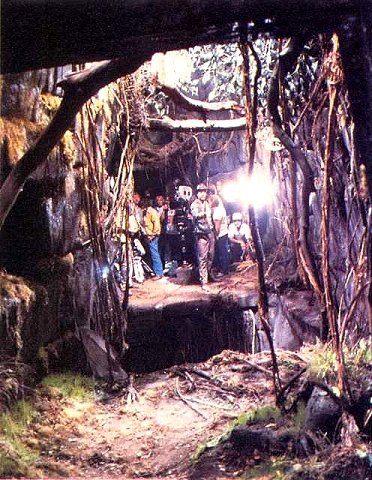
Next was the filming
of the South American temple
in stage four. The set was a
wonderful creation by Norman
Reynolds that captured the feeling
of the '40s serials with a Tarzan-like
atmosphere. Indy encounters
an ingenious system of booby
traps devised by some ancient
architect to protect the golden
idol he seeks. Poison darts
fly from the mouth of grotesque
stone faces, spears shoot out
from nowhere to impale their
pray and tarantulas await in
the cobweb-strewn darkness.
50 live specimens were recruited
by Spielberg and dropped at
the cloths of Ford and Alfred
Molina, who made his movie debut
with Raiders.
  
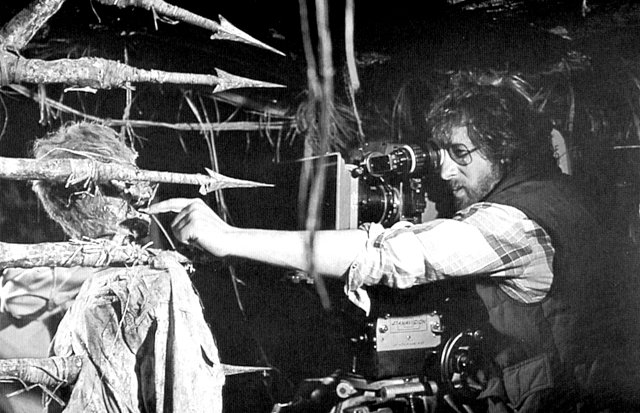
Spielberg
preparing the Forestall
scene and the big hole...
|
 
This
is what they name a 'traveling
shot' towards the golden
idol. |
When Indy takes
the idol from its shrine the
whole place is starting to tremble
and fall apart. In his way out
Indy finds himself pursued by
a giant boulder. His only way
to survive is by outrunning
the boulder and get to the exit
of the temple. Ford believed
that it would be more effective
if the audience could actually
see that it was he who was running
from the boulder and wanted
to outrun the boulder by himself
without the help of a stunt
double. Glen Randall felt that
Ford could actually made it
and suggested Spielberg to let
him try. The 12-foot boulder
was made of plaster, wood and
fiberglass weighted 300 pounds
and could have done bodily harm
to anyone falling underneath
it. The scene was shot from
five different angles, each
one done separately, each one
done twice, so Ford had to race
the boulder ten times and made
through all of them. When the
sequence was completed Spielberg
admitted, "He won ten times
and beat the odds. He was lucky
and I was an idiot for letting
him try".

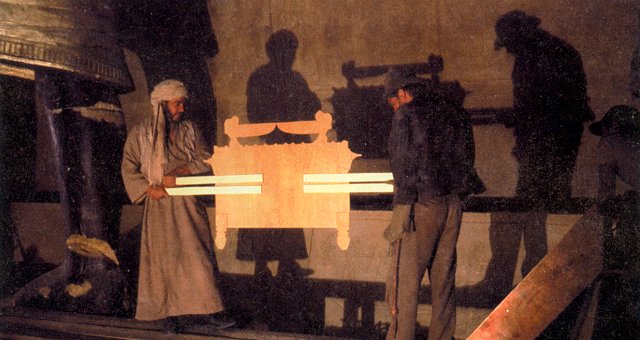
Carrying the 'real'
ark. |
|
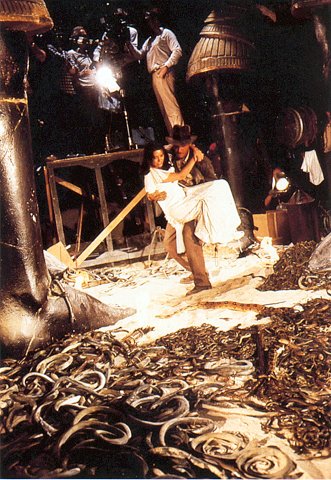
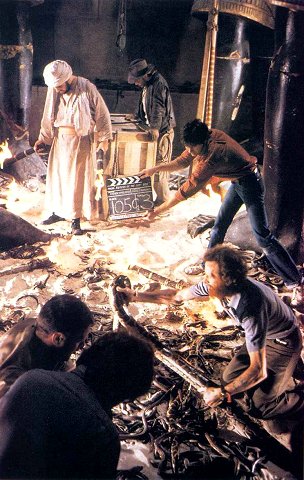
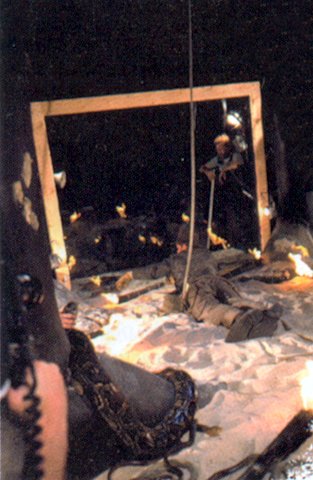
On July 14th started
the filming of the Well of Souls
sequence in Elstree's
stage three that lasted two
weeks. According to the script,
the Well of Souls is a hidden
chamber under the sands where
the Ark of the Covenant was
supposed to be rested. When
Indy finds the Well he discovers
that the whole place is inhabited
by snakes. Spielberg wasn't
pleased with the number of snakes
they had on the set (about 2000)
and ordered 4500 more from Denmark
in order to achieve the horror
the script so well described.
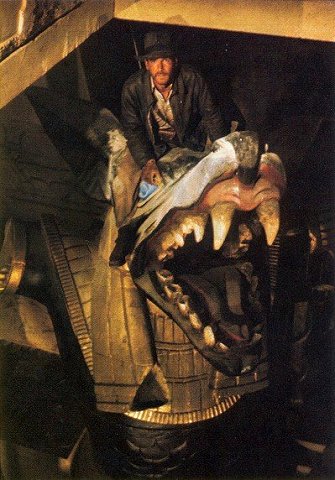
The set was designed as the
interior of a pyramid dominated
by three jackal statues over
35 feet tall. Indy would be
lowered in the pit from the
top of the statues and suddenly
would fall down only to come
face to face with a cobra. In
safety for the actors, they
could do nothing without an
anti-venom serum. The serum-man,
as Frank Marshall called him,
couldn't come through with the
serum and he was the only one
in the country. They went to
a hospital but the serum there
was out of date. Finally, the
serum arrived from France with
a little help from the American
Embassy, the Air Force Hospital
and the Naval Hospital. During
the filming of the scene the
doors of the stage were open
permanently, and an ambulance
was backed inside with its doors
open. Standing in either side
were two enormous men in white
coats, with a syringe in each
hand. Every unit member wore
protective clothing high rubber
boots and strengthen canvas
trousers and jackets. Day by
day the cast and crew got used
to the snakes, the tension had
gone and came back with the
cobra. The cobra killed a python
that's been trying to bite people.
  
"Oh
my God! This whole place
is slithering!"
|
John Baxter in
his book Steven
Spielberg An Unauthorized Biography
mentions another problem the
production team faced when Vivian
Kubrick, daughter of famous
director Stanley Kubrick, complained
because of the way snakes had
been treated. She claimed that
many snakes had been crashed
from the feet of the cast and
crew. She even climbed up on
the stage and said: "Steven,
this is so cruel". Spielberg
from his side felt terribly
embarrassed and reassured her
that they would be looked after
fine, but she wasn't pleased
with that, so she rang the RSPCA
to complain. The whole film
ground to a halt and it was
closed down for a whole day.
In order to continue shooting
Spielberg ordered measures to
be taken. So a row of plastic
dustbins as far as the eye could
see around the stage, and in
the bottom of each one there
was a little bit of straw and
a leaf of lettuce, and each
one had about three garter snakes.
 
It's
the cobra who's taking safety
precautions... |
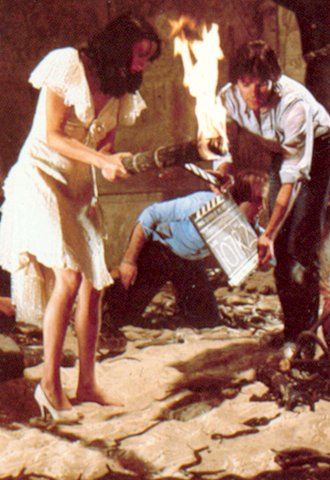
Ford and Allen
had to stand in the center of
the set with more than 6000
tangles sizzling around. Even
though snakes are Indy's worst
nightmare, they didn't bother
Ford, since as a teenager he
loved snakes and even collected
them to put on display. Poor
Allen had to wear only a white
evening dress with her arms
and legs naked. When things
began to turn rough, Wendy Leach,
Allen's stunt double continued
her scenes and when things became
really nasty, animal handler,
Steve Edge, put on Marion's
dress, shaved his legs and finished
her shots. The Well of Souls
scene was proven one of Allen's
worst experiences because she
knew that pythons aren't poisonous,
but they bite and hold on. That
scared the hell out of her,
and every time a snake got near
her bare feet she turned around
and walked straight off the
set. And there is more. Spielberg,
because he thought that she
wasn't screaming for real, put
her through numerous "tortures"
like tossing tarantulas on her
leg or throwing snakes at her
head. "Whenever she didn't
see me, she would look up",
said Spielberg later.
 
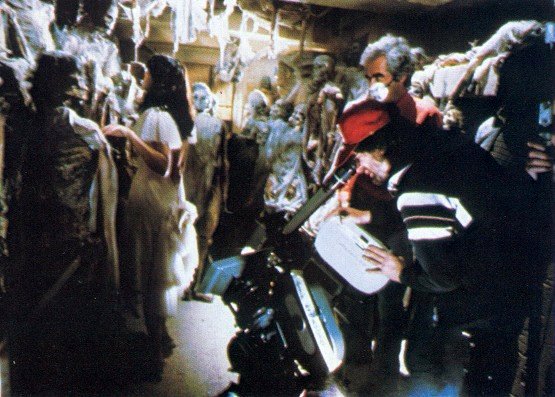
Karen
Allen surrounded by mummy's. |
Right next to
the Well of Souls set was the
Catacombs set from which Indy
and Marion would escape. The
set was narrow, delicately designed
with scarcely enough room for
the essential personnel. Inside
the catacombs Marion and Indy
meet the terrifying results
of the art of Tom Smith, chief
make-up artist on Raiders.
In creating the catacombs scene,
following after all the activity
and movement of the Well of
Souls with its snakes and fire
and falling statues, and enemy
figures condemning Marion and
Indy to suffocate and rot George
Lucas, Steven Spielberg and
Lawrence Kasdan had introduced
enormous visual horror. Within
the narrow set were skulls and
many rotting bodies - the mummies
that would terrify Marion Ravenwood
and cause her to say, "This
is the worst place I've ever
been."
Tom Smith created those moldering
mummies. In order to insure
that the models should be as
accurate as possible, he began
by sending to the London College
of Surgeons for real skulls
as examples, to get the dimensions
right. By stages, using a variety
of modeling materials, from
primitive to advanced chemical,
he set about making full corpses
in various stages of decomposition:
hideously real decaying cadavers,
so real that you could believe
not only that they were dead,
but also that they had once
been alive. Karen Allen spent
eight or nine days by herself
having corpses and skeletons
falling on her, "huge amounts
of dust falling into my eyes
and mouth. Before we had spent
two weeks in the snake pit.
At times it was challenging
to figure out what I was doing,
with snakes all over the place.
It was difficult and unsatisfying
in a way. I've done films like
that since, such as The
Perfect Storm, where
sometimes you spent a whole
day just drinking a lot of water,
fighting for your life and screaming.
But at the time (during the
shooting of Raiders),
I couldn't figure out what it
had to do with acting."
The truth is Allen wasn't particularly
happy with the way Spielberg
was working because she wanted
to rehearse. She found it frustrating
that she wasn't able to explore
her character and make it more
immediate. During the movie
she was always talking about
how she was going to use the
money to go back and set up
a theater company. Her anger
had increased during the Well
of the Souls sequence. Though
stunt artists replaced her when
Marion hangs over the pit and
the statue collapse on her,
there were more than enough
anxiety as she faced the snakes.

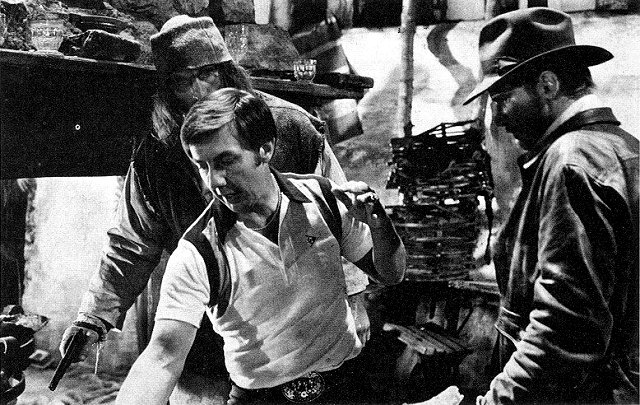
Preparing a bar fight. |
|
The Raven Bar
scene started filming on stage
two while stuntman Martin Grace
performed the stunt of the falling
statue in the Well of Souls.
Located in the Himalayas the
Raven was another wonderful
creation of Norman Reynolds.
The furniture, the drinks on
the shelves, the wonderfully
sandblasted and old-looking
fireplace all in period. And
the overall aura of the place
is "mountains" and
it feels right. This is one
of the most dramatic scenes
in the film. It introduced the
character of Marion Ravenwood
but also established the relationship
between her and Indy. Unfortunately,
in the final cut of the film
most of the dialogue in that
scene was cut out causing Lawrence
Kasdan's frustration. "Some
of the best writing I've ever
done was in that scene, but
all that's left is its beginning
and end."
On August 14,
Spielberg and company visited
the Rickmansworth
Masonic School in England,
an old institution found in
1788 by Chevalier Bartholomiew
Ruspin, for on location filming.
The school set in 400 acres
of parkland was perfect as both,
Indy's teaching college and
the Washington D.C. Government
office. Suddenly, Robert Watts
was taken to the hospital, on
August 18, for an appendix removal,
with his duties falling in the
hands of Frank Marshall. Fortunately,
Watts recovered very soon and
he was back on the set a month
later.
With interior
shots completed, the production
moved to North Africa to film
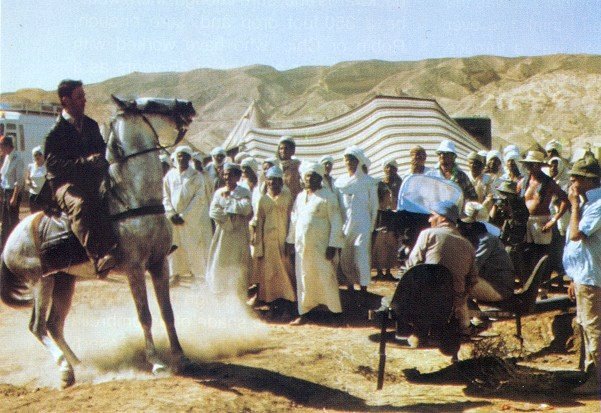
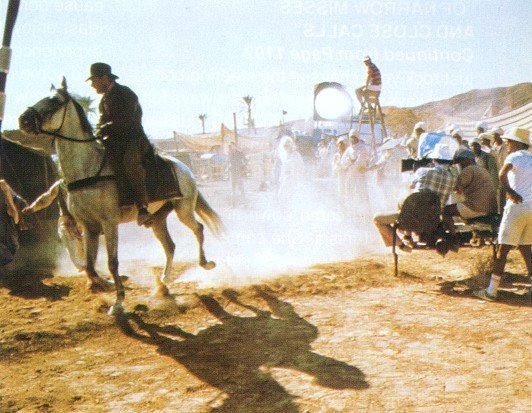
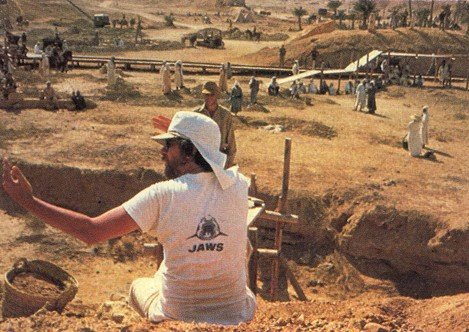
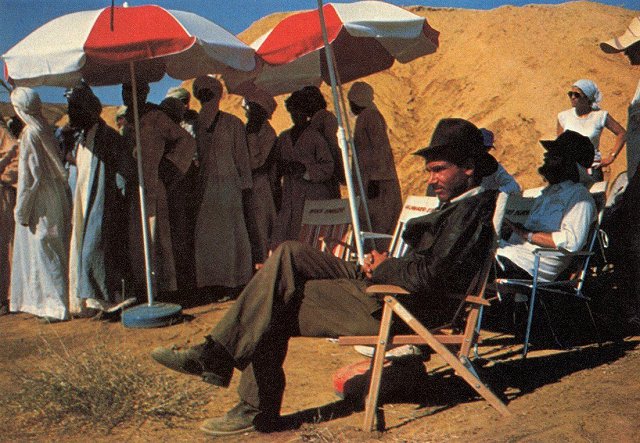
the German excavation site for
the lost city of Tanis. Located
in the Tunisian desert of Sedala,
near the town of Tozeur, the
70 acres set perfectly designed
by Norman Reynolds captured
the vision of George Lucas and
Steven Spielberg. Filming under
the Tunisian sun with temperature
hitting 130 degrees was a nightmare,
especially for the 600 Arab
extras, which started to complain
when water supply problems emerged.
Under these conditions Spielberg
was working in a frantic pace
to bring the film on schedule,
averaging 35 setups a day. A
number unthinkable for a Hollywood
movie, but Raiders
were inspired by 1930s B-movies
and that's how Spielberg envisioned
this film. "On Raiders
I learned to like instead of
love. If I liked a scene after
I shot it, I printed it. I didn't
shoot it again seventeen times
until I got one that I loved",
said Spielberg.
  
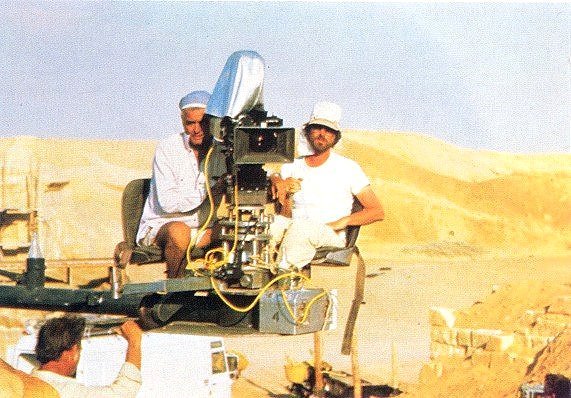
Filming the Tanis dig site
scenes near the town of
Tozeur... |
  
...
under the Tunisian sun with
a temp. hitting 130 degrees. |
George Lucas visited
the set in Tunisia for two weeks
and even directed some scenes.
On the very first day he got
badly sunburned and was forced
to cover his face and ears with
tissues. That made the crew
give him the nickname Howard
Huge. But his skin was permanently
damaged and ever since when
he would expose to the sun his
face would turn bright red.
Despite his argue
to finish on time Spielberg
managed to improvise many scenes
during filming. Like the tent
scene, Indy's student that had
written on her eyelids "I
love you" and the Bantu
Wind cabin. Little scenes that
added a laugh and gave the audience
the chance to ease adrenaline
after all the running and fighting.
Ford, continued
to do most of his stunts risking
the production's existence and
even his own safety more than
once. There were times where
he was injured in a daily basis.
"It's true, you can do
a lot of stuff yourself. And
I'm glad to if the stunt is
coordinated so that there is
an advantage for the film in
my doing it myself. I don't
want to do it for glory. But
sometimes I begin to feel more
like a football player, a battered
football player than a movie
actor." Having escaped
from the Well of Souls, Indy
and Marion watch the Germans'
moves. Indy trying to snick
in the airplane, which would
travel the Ark to Germany, gets
detected by a mechanic who challenges
him to a fight. The fight takes
place around the whirring propellers
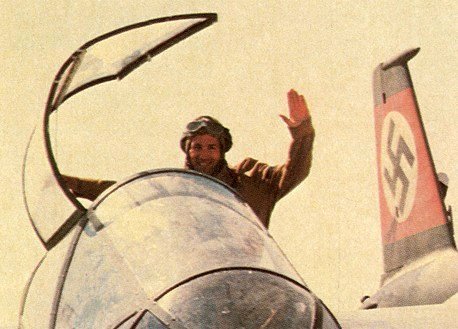
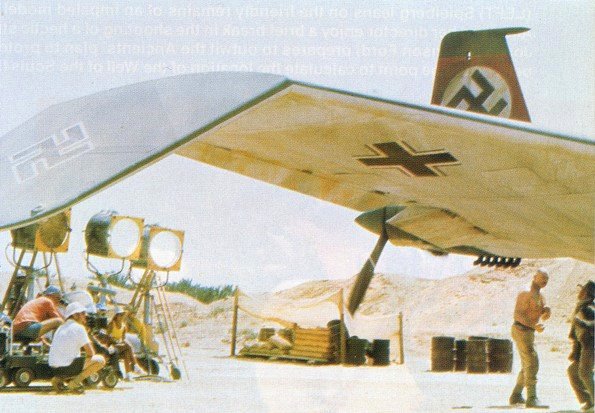
of a Flying Wing with Indy trying
to avoid the German. Artist
Ron Cobb designed a prototype
Flying Wing that, with its end
wing flaps tilted downward,
was closer to the look of a
US prototype developed in the
40s. The final, life-size airplane
was built by the Vickers
Aircraft Company, in
England, and painted at
Elstree
studios. Once completed the
aircraft was disassembled and
shipped to Tunisia, where it
was rebuilt on location.
  
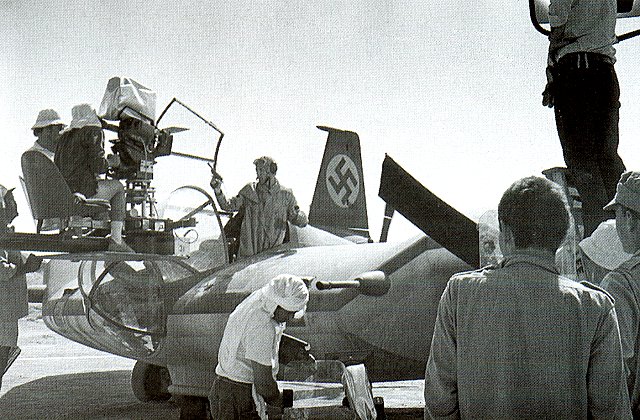
Producer
Frank Marshall playing the
Flying Wing pilot. |
  
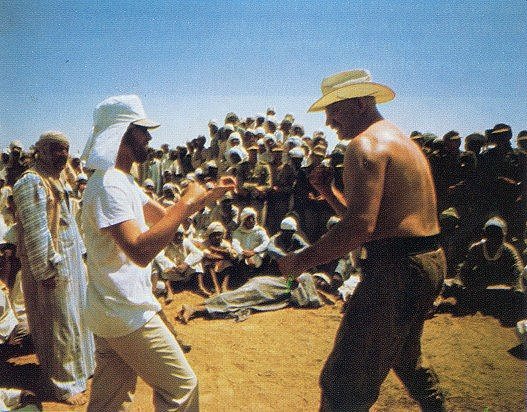
Steven
Spielberg teaching Pat Roach
(German mechanic) how to
fight. |
In one of his
efforts Indy is knocked down
into the path of the airplane's
wheel and does a backward sauversault
to avoid being crushed. The
scene was successfully rehearsed
a number of times but when the
camera started to roll Ford's
right foot shipped in the sand
shot sideways. He caught his
toe under the tire of the advancing
Flying Wing, which proceeded
to crawl up his tibia. Luckily,
the brakes worked inches before
his knee was crushed, but he
was pinned to the sand. Thanks
to the blistering sun the tires
had gone soft, so when the wheel
caught Ford's foot "he
suffered nothing worse than
a worn set of lungs from the
scream he unleashed", said
Spielberg to The
New York Times.
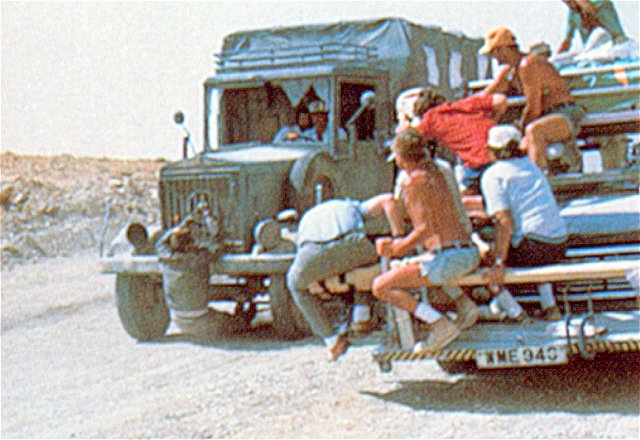
The film included
a great chase sequence involving
a truck, a jeep, a motorcycle
and a horse, equivalent to the
stagecoach chases of the old
serials. As with the Flying
Wing the production team created
all the required vehicles. Indy,
on horseback, rides alongside
a truck that carries the Ark,
yanks a passenger from the truck
and throws him into the road.
Then he fights the driver and
he drives the truck himself.
A German sergeant climbs back
over the roof down onto the
cab. He comes in through the
window and hits Indy sending
him out through the windshield.
Indy shot over the front of
the truck, hangs on but eventually
loses his balance and falls
underneath. Indy hangs underneath,
gets his bullwhip out, ties
it under the truck and is dragged
along. Eventually, he pulls
himself back into the truck,
climbs through a big hole in
the side, gets back in, gets
rig of the driver and drives
the truck to Cairo.
 
Stuntman
Terry Leonard risking his
life while Ford takes a
break. |
Spielberg who
had never used a second unit
director before agreed to do
so only for the truck chase
because it was a very extended
pursuit and covered a lot of
different locations. The second
unit began shooting the truck
chase a week before the production
moved to Tunisia, so they were
well into it when Spielberg
arrived at Nefta. He directed
all the shots involving Ford.
For his own protection when
Ford was filmed hanging in front
of the truck he was actually
sitting on a bicycle seat attached
to the vehicle's chassis. Mickey
Moore did everything involving
wider shots using doubles. Even
though Moore followed all of
Spielberg's storyboards to the
letter, he also gave him one
or two extra shots for each
storyboard, "and sometimes
the bonus shots were better
than the storyboards" admitted
Spielberg.

Production's next
stop was the city of Kairouan,
at the North East side of Tunisia,
which served as 1936s Cairo.
There a whole day was lost because
350 TV antennas had to be removed
from the houses around the building
that served as Sallah's home.
During a walk
in the Cairo streets Marion
gets kidnapped and Indy is running
around trying to find her. As
he is looking for her he confronts
a black-dressed Arab with a
big sword on hand. According
to the script Indy uses his
whip to beat the swordsman.
The Arab does a show off with
his sword. Indy does his own
with the whip and the big battle
begins. Ridiculously, most of
the crew, during the Tunisian
shooting, was afflicted by dysentery.
Everyone, except Spielberg who
had brought his own food, in
cans. So, Ford wasn't in the
best of moods for such a big
and difficult scene, although
they had rehearsed it, since
he had to keep going to the
toilet very hour. He approached
Spielberg and said: "Steven,
I can't do this, let's just
shoot the son-of-a-bitch!"
Spielberg's respond was "I
was thinking about doing the
same thing" and so they
filmed it getting one of the
picture's best laughs.
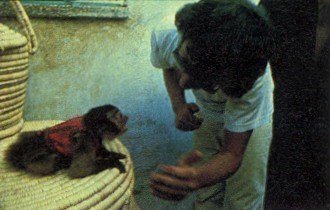
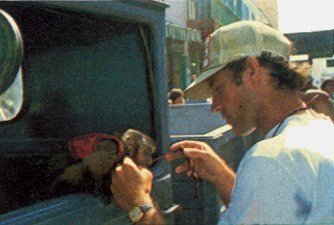
Meet
George, the infamous Nazi-saluting
monkey. |
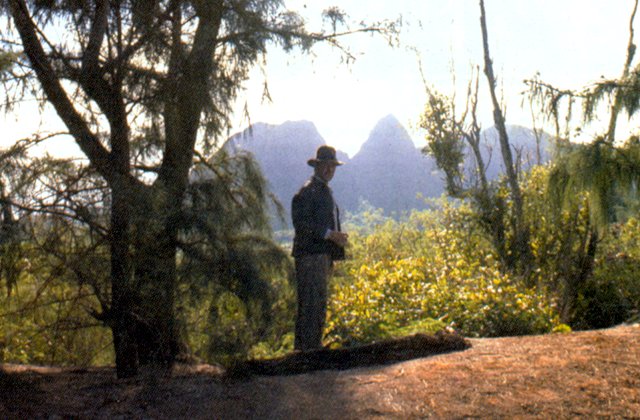
On September 29,
the production arrived in Kauai,
Hawaii, for the opening scene
of the film. The very next day
filming started in a place that
served as the exterior of the
South American temple. It was
a pit, like a mini-canyon and
included a pool and a waterfall.
The location was really great
but it was difficult to get
to. They had to build steps
down an almost sheer cliff to
get into it, and all the heavy
equipment had to be put in with
a crane from up above. Worst
of all, the pool was the breeding
ground for thousands of mosquitoes.
They had a man with a mosquito
fogger every morning and got
their selves covered with anti-insect-bite
oil but they still got bitten.
  
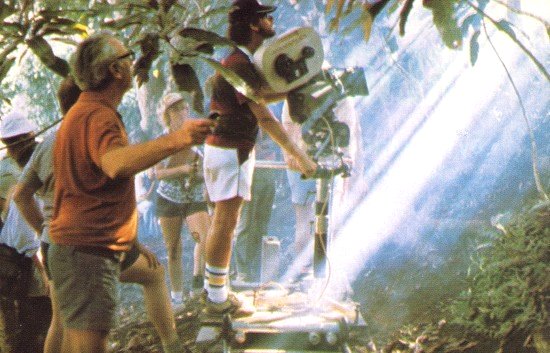
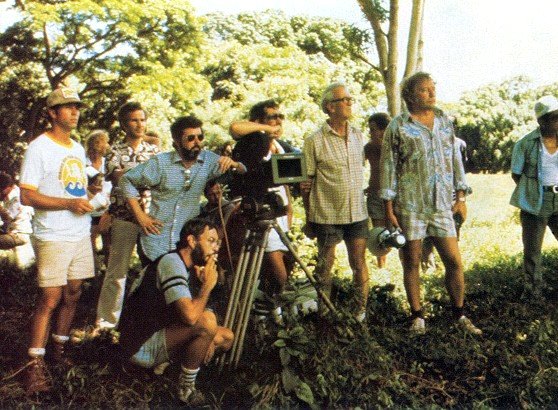
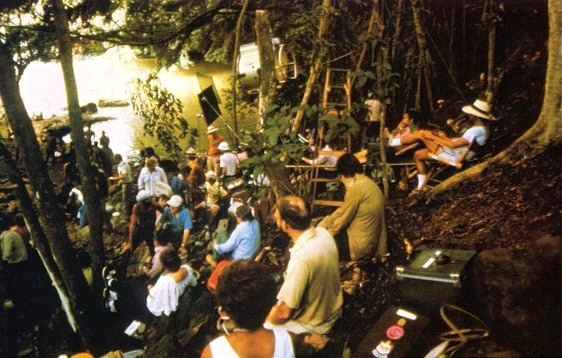
Crew
filming Raiders
opening scene on location
in Kauai, Hawaii. |
On Saturday in
Kauai they did treks up what
was supposed to be South American
mountains. They had two donkeys
that they used for all these
treks on Kauai for both the
first and second units - the
donkeys went lame. All Sunday
they were trying to find donkeys
on the island of Kauai because
they needed them continuity.
They didn't find any on Sunday;
Monday morning they found two
donkeys. They were the wrong
color so they painted them brown
with hair spray. They were going
to shoot on the Nepali coast,
which could be reached only
by helicopter. Not only could
they get in only by helicopter,
they now had two donkeys which
they'd had painted from gray
to brown, and they had to get
them in by helicopter as well.
So they bought a crate, got
this helicopter a hook, blindfolded
the donkeys, and one at a time
they were hooked under the helicopter
and flown into location.

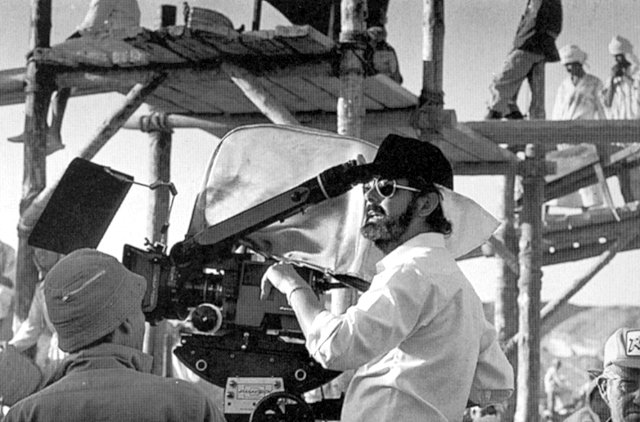
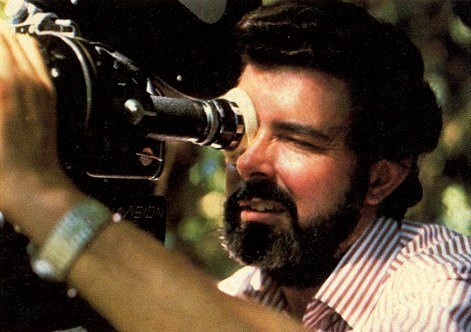
Lucas behind a camera.
|
|
After an exhaustive
search for Indiana Jones' South
American escape plane, this
1930s Waco biplane was finally
located in Junction City, Oregon.
Owned and cherished by Henry
and Alice Strauch, the plane
was the only one found that
fitted all the requirements
of the movie - single engine,
open cockpit and the original
floaters which allowed for landing
and taking off on water. Production
designer Norman Reynolds had
the plane painted to match the
aircraft of the period, and
added a small touch of humor
as well - note the use of the
two Star
Wars characters OB (as
in Obi-Wan Kenobi) and 3PO as
the plane's identification numbers.
This valuable antique plane
finally returned home to Oregon
and its regular routine - Henry
Strauch flew it to work and
back each day.
The last location
to shoot was on the Nepali Coast,
which could be reached only
by helicopter. They had to take
everything in by helicopter,
including two donkeys. It was
there that another accident
took place. The scene called
for Indy to run to the bank
of the river, chased by natives,
jump into the water swim towards
the airplane, climb up, get
in and fly away. All in one
shot. As Ford was climbing up
his legs dangled with the plane's
right flap and made steering
difficult. So when the plane
reached an altitude of twenty
feet, it disappeared behind
an outcrop of trees and crashed.
Miraculously, Ford and the pilot
escaped unscratched and returned
to do the scene again.
 
Preparing
the Paramount
logo opening shot. |
Next:
Concluding the adventure >> |