| In
one of their early meetings
Spielberg had expressed interest
in working with Frank Marshall,
a young producer who had worked
on many small-budgeted films
and who he hoped to help him
bring the film in on time and
on budget. So Lucas phoned him
to set a meeting at his place.
Later that day Spielberg, Lucas,
Kasdan and Marshall met and
Lucas introduced him as the
film's producer. An hour later
they all shook hands and Lucas
said: "We're making movie
history". A production
team had begun to form. Lucas,
along with an old fellow student,
Howard Kazanjian, would be executive
producers. "We really needed
someone who would not be a nice
guy. It's hard to be a tough
guy in that situation. Howard
can do it", was Lucas explanation.
Spielberg then hired Douglas
Slocombe as director of photography
and Michael Kahn as editor.
Spielberg had worked with Slocombe
for two weeks during the making
of Close
Encounters of the Third Kind
and was interested in working
with him on a complete feature.
Michael Kahn had edited the
two previous films of Spielberg
and ever since he had become
one of his standard collaborators.
Lucas suggested Robert Watts,
who had worked on Star
Wars and The
Empire Strikes Back as
associate producer. Production
designer's duties were assigned
to Norman Reynolds, who together
with Watts were brought aboard
in November 1979 to discuss
logistics. A month later they
went off for location scouting.
Shooting was to begin in the
spring of 1980.

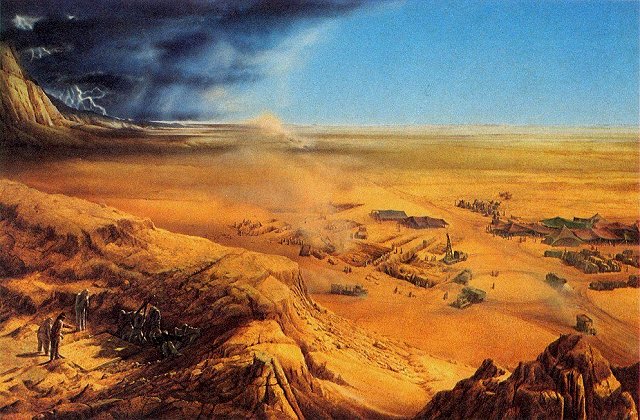
Tanis dig site sketch. |
|
Dale Pollock,
George Lucas' biographer, in
his book Skywalking
wrote that Lucas initially wanted
to finance the film by himself
but he couldn't because he was
facing cash-flow problems. Tom
Pollock, Lucas' Hollywood attorney,
and Charles Weber, Lucasfilm's
financial chief, offered the
script to every major studio,
while Lucas and Spielberg drew-up
a one-page contract between
themselves. Weber sent out a
form letter with the script
to every studio. What they wanted
actually was the studio to put
up all the money, take all the
risks, and give them the best
terms anyone ever got. Studio
chiefs were outraged with what
became known as Lucas' "killer
deal", but everybody called
up within an hour and said they
wanted to talk with them.
Paramount
Pictures' President Michael
Eisner said it was an unmakable
deal. But Eisner had never read
a better script than that, and
the idea of turning down a film
by Hollywood's dynamic duo made
him uncomfortable. In order
to balance their demands Eisner
wanted the sequel rights to
Raiders
and strong penalties against
Lucas if the film went over
budget and schedule. Eisner
got his penalties on the terms
that Paramount
would distribute Raiders
forever but they won't have
the right to produce any sequel
without Lucas' involvement.

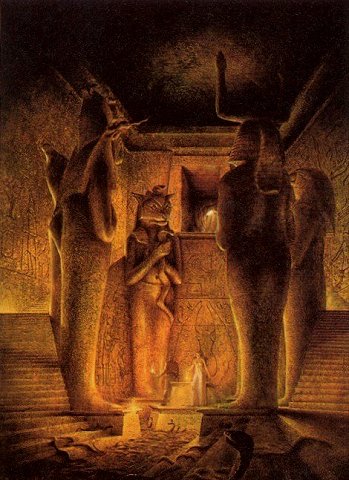
Well of Souls sketch. |
|
As Pollock continues
his description of the deal
he mentions that because of
Lucas' lack of trust towards
Hollywood studios he refused
to honor anything other than
a signed contract, leaving Paramount
wonder if he would be part of
the project or not. "All
he said was 'Trust me'".
So we had Spielberg who had
spent a lot of money to make
1941,
George saying trust me and us
having to guarantee completion
money for a film that might
cost $50 million. It was not
a standard deal, to say the
least", said Eisner. Paramount
was in panic and George Lucas
was enjoying this. Why? Because,
during the making of Star
Wars Lucas was near a
nervous break down from the
pressure he felt from the studio.
At the last days of filming
they were threatening of taking
the film from his hands, cut
the negative and send it right
to the theaters. Now it was
time for Hollywood and its studio
executives to taste some of
their own medicine. The contract
they finally signed dictated
a $1 million directing fee to
Spielberg, $1 million producer's
fee to Lucas, and another $1
million to Lucasfilm as the
production company. Spielberg
also was guaranteed a percentage
of the gross profits; the money
Paramount
would receive from theater owners
while Lucas would have to wait
for net profits.

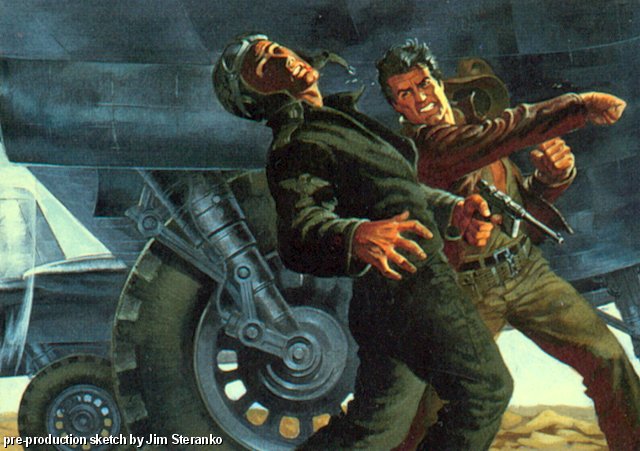
Flying wing fight
sketch. |
|
Eisner had accepted
everything except Lucas' refusal.
In an effort to find a solution
he called Bill Huyck and Gloria
Katz, who made a film for Paramount
and were long friends with Lucas.
"You blew it, George wants
to be trusted", they told
Eisner. The very next day Eisner
called Weber and accepted the
terms. "I just decided
to go the whole way. And once
I said 'I trust you', it was
the most professionally produced
film I've ever seen. Not a dime
over budget, handled totally
smoothly, and never a fight.
When he said it, I believed
it", said Eisner in the
times to come.
The film's budget
was defined to $20 million and
it was to be shot within a 85-days
schedule. Spielberg, after all
the negative publicity he had
received for overcoming the
budget and the schedule for
Jaws,
Close
Encounters of the Third Kind
and especially 1941,
was determined to bring his
next film in on time. For this
reason he, together with Lucas
and Marshall made a secret schedule
of 73 days while at the same
time they cut off some scenes.
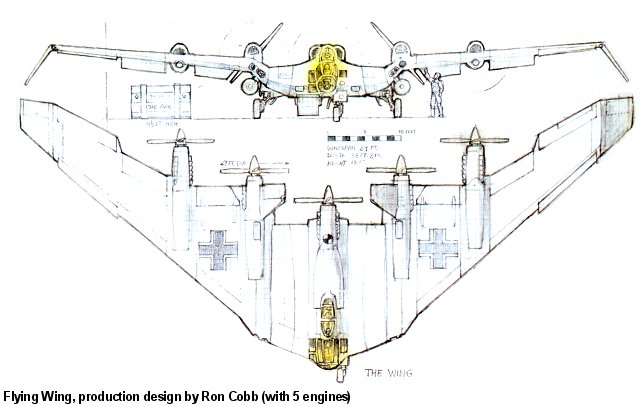
For instance, the scene in the
Nazi base where Indy finds super-weapons
disappeared and an experimental
Flying Wing was abated from
five engines to two, while the
whole Shanghai sequence was
deleted. Ron Cobb, one of the
film's production artists, had
enjoyed elaborating Toht, giving
him a Strangelove-like mechanical
arm with a machine gun firing
through his forefinger, but
this too was ditched.
  
Flying
Wing production sketches
& one of Toht with a
mechanical arm. |
It was decided
that the production would be
based, like Star
Wars, in England. Elstree
studios, outside London,
had served Lucas well during
the making of his film. Elstree
studios with its seven
stages and its extent of 27
acres made it ideal for Raiders.
As John Baxter rightfully noticed:
"These were historic premises".
Many famous men of the cinema
had passed through. Men like
Alfred Hitchock, David Lean,
Michael Powell and Ronald Reagan.
Additionally, they knew that
there they would find a well-oiled
machine of technicians and artists
who had been working together
since 1976. By working on films
like Star
Wars, The
Empire Strikes Back and
Superman
they had become accustomed to
difficult locations, spectacular
sets and eccentric special effects.
In order to plan
his film as well as he could,
Spielberg hired four illustrators
and gave to each of them parts
of the script. Based on this
and some rough sketches Spielberg
had made himself the four artists
managed to storyboard about
80% of the film, nearly 6000
images. Spielberg kept to about
60% of that. And that wasn't
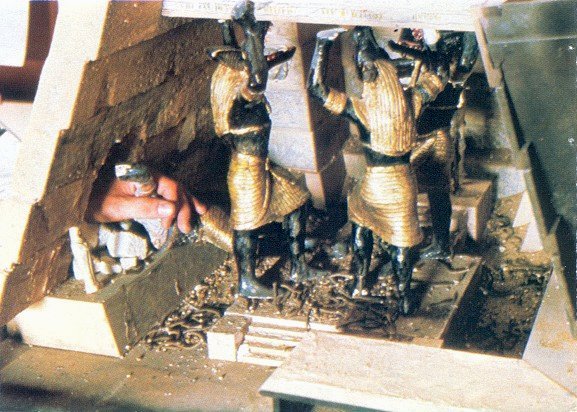
all. He had the art department,
in Elstree,
built scale models for each
set. The miniature of the now
famous dig site filled an entire
room. This proved very valuable
to Spielberg because it helped
him keep the cost to its ground
and find the right angles to
photograph his scenes.
 
Well
of Souls scale model &
Spielberg overlooking his
dig site. |
Next:
Casting,
if the hat fits >> |