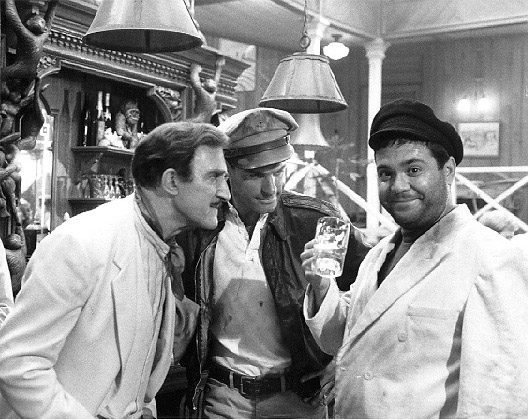
Stephen, was there a character
you modeled your performance after?
Stephen Collins:
I was partially inspired by Cary Grant in Howard
Hawk's great, but little known, movie, Only
Angels Have Wings. Grant plays against type
as a tough character who flies mail in and out
of a tiny, mountainous country. It's a great film,
and a great performance.
How aware were you of the inspirations
to this character from the creator and writers
vantage point? In other words, were there discussions
with you about old movie stars or movies they
wanted you to emulate with Jake Cutter?

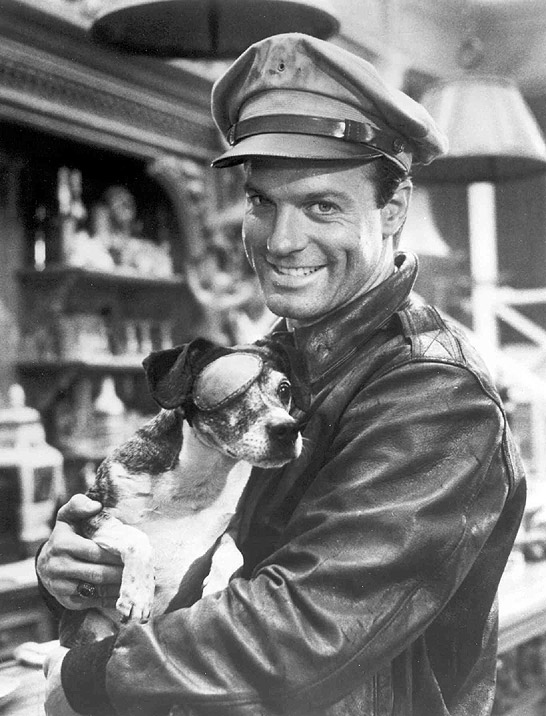
Collins
as Jake Cutter. |
|
Stephen Collins:
Not really. Don Bellisario had a sense
of what he wanted and we talked about it, but
he didn't ask me to copy anybody. I knew about
Only
Angels Have Wings, and Don got a copy of it
and screened it for me and Jeff MacKay, which
was great. From that moment, I think Jeff and
I were in the same wavelength.
How close did the show come to
matching its ideal and original concept?
Tom Greene:
First of all, remember that Gold
Monkey was the 100% brilliant brainchild
of Don Bellisario. The two-hour pilot, which I
thought was amazing, and better than most features
of the day (and had up to then, and maybe still,
the most amazing set ever created for a TV show)
had the look and feel of a more sophisticated
action-adventure show. This, I believe was Don's
intention ... to create something that had that
"Great White Hunter" feel to it, however
had a maturity of character and situation, that
would get both the young viewer and one who was
a bit more discriminating. As Don would say, the
next half dozen shows or so, started to go in
a different direction, becoming much more comic
book than the vision Don had. You had mud people
and exotic "monsters", etc. Some of
that may have been a nervous network, and some
of it may have been just experimenting with different
ideas, and also as Don would tell me, some wrong
choices in writers. At the time I was producing
his other hit series, Magnum
P. I., and Don asked me if I'd like to
come over and become a writer-producer on Monkey.
As much as Magnum
was a dream job there was something about Tales
that had me totally enthralled. I found myself
on the sets all the time, just to soak in the
"world" he created. I was also good
friends with Steve Collins, and was a huge fan
of Roddy McDowell, so to work with them was also
an exciting prospect. And then there was the "hands
on" aspect of Monkey
in that Magnum
was shot in Hawaii, and I was their Hollywood
producer, which meant I worked on scripts, casting
and post production, and obviously wasn't on the
set. I love being on the set as much as possible,
so I jumped at the chance to go over to Monkey
(which was shot on the Universal lot). I had a
lot of discussions with Don about how he wanted
to get Monkey
back on track, and after that, went off, and over
a weekend wrote for him, my first script: "Force
of Habit".
“Force of Habit"
was one of the best episodes, so brilliantly balanced
humor and poignancy, the desires of the flesh
and respect for religion. Anybody ever say, “Hey,
this is a kid's show! Don't work so
hard!"
Harvey Laidman:
I didn't have any highfalutin' goals
shooting it, just make a fast-moving adventure.
Tom Greene:
I'm very proud of that episode. That episode had
a two-fold purpose. First of all, Don wanted me
to write what is called a "ship in the bottle"
show, that is a show that was very "contained",
so that we could bring the budget back (it was
written so that much of the action takes place
in the cockpit of the "Goose"), and
secondly, he wanted to bring the show back to
a more mature direction, where character and plot
took precedent over gimmicks and monkey suits.
I think after that the show did get back to Don's
original concept, and with his guidance, and the
help of our extremely talented story editor, George
Geiger, the rest of the shows pleased Don, since
they evolved into his original concept. You also
have to give Harvey a HUGE amount of credit for
that, since he is one of the best directors in
the biz, and it was his talent that kept the balance
of humor and poignancy. I've used Harvey in virtually
every show I produced ... and for good reason.
Don never, ever thought of this as a "kid's
show", and as I said, he pushed us, to exhaustion
and beyond at times, to make the show as good
as possible. On the contrary to the idea of: "don't
work so hard", Don expected everyone to work
as he did: 20 hours a day, seven days a week.
I must say, many marriages and relationships (mine
included!) were brushed under the carpet because
of our dedication to Don's vision. And that's
why this show stays so alive with so many fans
who feel so passionately about it. They can sense
the passion we felt as well. As a writer there
are rare and wonderful times when you are truly
inspired, and you find that the words just come
ripping out of your fingers. It's like you are
watching the movie or the TV show and are simply
a "court reporter" writing down what
you see. It literally unfolds before you in the
big screen in your brain seemingly on its own.
Those are the moments we live for. This episode
was just that. As I said, Don wanted a "ship
in the bottle" show, so the obvious idea
was to make much of what happened in the cockpit.
I then had to come up with an idea of who Jake
would be in the cockpit with, and how to make
it interesting. Of course, anything to do with
a romance is much more interesting than a "bad
guy", or just talking to his sidekick, Corky
(by the way, one of the great unsung talents and
heroes of that series was Jeff MacKay.) If I remember
correctly they had an abandoned story that Don
hated but it had, I think a Nun in it. He never
showed me the story, but he did tell me something
about it, and suddenly when he said "Nun",
I was instantly intrigued by the idea of Jake
in a cockpit with a "Nun". Being a Jewish
Cowboy, and not knowing very much about "Nun's",
I did call a friend who had been a "Nun"
and left and subsequently married. But she had
spent years in the "service", so I talked
to her for hours, and got all that wonderful dialogue,
so that it would be accurate. The other inspiration
came from an actress named Elizabeth Huddle. I
had just seen her in a one woman show called Sister
Mary Ignatious Explains it All For You
where she played a Mother Superior. I simply stole
her amazing character from that show and brought
her to Gold Monkey.
So then I had a great character, who was once
Jake's love interest, but now was about to take
her final vows as my character in the plane. Anyway,
it all came together, and because of the reoccurring
characters that Don had created, the story worked
beautifully. I'm most proud of the scene in the
beginning when Jake thinks the Nun, who he recognizes,
is pulling his leg, and is just wearing a "nun
costume" so he goes up to her, grabs her
by the ass and gives her a deep tongue kiss. The
expression of everyone around him is priceless,
especially Steve himself as he slowly realizes
it was no costume! If you look at the shows after
that they also had that nice balance. Especially
"Last Chance Louie," which is very emotional.
In fact I wrote that with our story editor George
Geiger, who spoke French (as did his wife), and
we basically wrote a version of Tale
of Two Cities. We did something very unusual,
in that the trial of Louie for murder is written
all in French, and Don fought the network to not
only let us do that, but without subtitles! Again
his inspiration, allowed us to create stories
like that. Roddy's performance in that episode
is especially poignant as he is willing to die
to protect his daughter. One quick side note on
that episode: in the story, Steve falls in love
with Louie's Daughter. She was played by Faye
Grant, and in real life, they both fell in love
with each other while filming the show, got married,
and are still married!
The vast majority of TV
shows that last one season don't have cult
followings years later. To what do you ascribe
the lasting value of Gold Monkey?

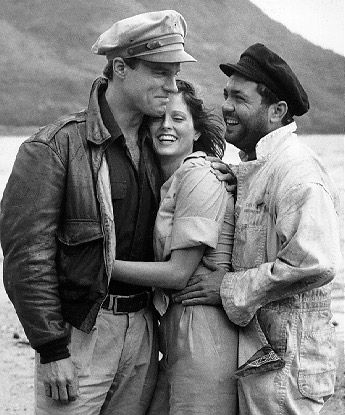
Collins &
MacKay with
Caitlin O'Heaney. |
|
Stephen Collins:
It appealed to people's sense of fun and adventure.
The characters were real and cared about each
other. It was funny and it had heart. Brandon
Tartikoff told me two years after we were cancelled
that he thought Gold
Monkey could have run as long as MASH.
But ABC didn't know what they had. Tartikoff ran
NBC.
Jeff MacKay:
Good family values. Imagination. A return to more
innocent times when integrity and goodwill meant
something. Honesty as a norm as opposed to something
unusual. People that you could rely on to be the
people that you see... not having to look beyond
the surface of the personality to see the real
human being. We also had a lot of fun making the
series. I think that always shows in the final
product.
Tom Greene:
You'll find cult followings for so many short-lived
TV shows, or movies that originally tanked at
the box office (of course It's
A Wonderful Life being the prime example
of that), become classics because the men and
women who originally made them had a passion for
the subject. They didn't make the show to try
and capture a fad, or simply for the money, or
because their "test results" and "focus
groups" told them it would work. They made
it because there was something deep in them that
they wanted to share. And they had the strength
and conviction of a single-minded vision to pull
it off. Of all Don's successful shows, I think
Monkey expresses
his true deep felt spirit more than any other.
And luckily at the time, he had the control to
pull it off. That brings me to the second reason
something becomes a "cult", and that
is that in those situations, the creator had full
power to make the show with their own vision.
There was no 12 year-old executive to tell him
what to do. The artist is given, for the most
part, free reign to create their vision. When
that is done, and it's rare in TV and Hollywood
movies, there is a power that can't be created
with all the money and CGI in the world. And people
respond to it. That is why, for example, documentaries
are doing so well these days. Why did a movie
about Penguins walk all over the zillion dollar
"blockbusters" last year? Because the
passion of the artist was paramount, and people
reacted to it. Tell me what passion is involved
in the movie version of Bewitched,
or all the horrific remakes like The
Longest Yard? These are made by media whores
who think that they have some kind of recognizable
"franchise", and written, directed,
produced and acted by embarrassed talent who phone
it in for the money. That comes off, and is why
people stay away. It's interesting that the famous
Hatmaker, Baron
Hats, who has made basically every famous
hat for movies and TV for the last 75 years, has
in their shop in Burbank a "cult wall",
where hats from all the great cult classics are
displayed. They have a website,
where one can go and order reproductions of so
many of these and other hats. (Interesting that
they made Bogart's hat for Treasure
of Sierra Madre, and when Spielberg saw that
hat, he wanted "Indy" to wear the same
one, and Baron made that one for Temple
of Doom... and in fact also made many of
the hats for Monkey).
Point being, when you look at these cult hats,
you suddenly see something in common: a single-minded
vision of the creator, a strong commitment to
"no compromise", and a passion for the
subject. We see this now very strongly at the
Academy Awards when the Hollywood grind machine
movies win nothing, and the independent films,
that are created out of that passion, not only
win the awards but the hearts and minds of the
audience.
Harvey Laidman:
There's something wonderful about an adventure
that is almost like a childhood fantasy. When
I walked to and from school, I pretended I was
the Phantom. Those
pictures in my mind don't relate to the
new “adventures" that feature stunts
that exceed imagination. I think we all could
identify with Jake.
Jeff, was there a character you
modeled your performance after?
Jeff MacKay
as Corky. |
|
Jeff MacKay:
Actually, there were three. Thomas Mitchell in
It's a Wonderful Life
and Only
Angels Have Wings, Walter Brennan in To
Have and Have Not, and Curly Howard of
the Three Stooges.
I simply combined the aspects of the personalities
of these characters with characteristics of my
own personality. I love the helpless, but well-meaning
characters such as Mitchell in both movies; I
also loved Walter Brennan for his innocence; and
of course, Curly Howard for his insane sense of
humor. And hopefully, I brought my own personality
to the role. That is what an actor does: he brings
to a role that which he knows about a personality
or traits of a personality. That is what makes
a role played by a certain actor unique. Everyone's
experiences have been different; not to mention
the ways in which the human being playing the
part has reacted to such experiences. An actor's
job is to bring what he knows about that kind
of person (the character) to light. At the time,
I was doing a recurring role on Magnum
P.I., playing Mac. Don Bellisario and I
were great friends and many times we shared a
sushi lunch and discussed my upcoming character
in Gold Monkey.
I told him that I'd like the character to be a
cross between Curly Howard, Walter Brennan and
Thomas Mitchell. The part was written for me.
Don and I had done a couple of series together
and he knew what I could do. Another example of
'who you know, not what you know.'
Stephen, I've read that you were
involved in bringing Roddy McDowall to the show.
Could you discuss the extent to which you were
involved in various aspects of the show aside
from your performance as Jake?
Stephen Collins:
I just talked to Don Bellisario and Don isn't
afraid to listen to anyone who has a good idea.
When they decided to replace Ron Moody, who played
Louie in the pilot, I knew that Roddy was someone
who understood the world and style that we were
trying to create. Few people understood old movies
better than Roddy. And Roddy really wanted it,
which is usually a good sign. I always have a
lot of ideas, some of which are good and some
of which aren't, but Don would always listen,
and, like a good editor, keep the good stuff.
I also thought that Sarah White should have a
middle name, something that would make her sound
even more uppity. I suggested my real-life father's
middle name, which is Stickney. Don liked it and
Sarah White became Sarah Stickney White. Don is
wonderfully collaborative that way. |