Given that the
style of the show was a little more 1930's
than the look, I'm wondering, did the network
want you to shy away from too much that looked
like the thirties or were the concerns more budgetary?
Was there pressure to make it more like Indiana
Jones?
Tom Greene:
First of all, Don had the number one show in the
country at the time with Magnum,
and actually the word in the streets on Monkey
was that it was a hit. Everyone, and I mean everyone
was blown away by Don's attention to detail, and
the multimillion dollar look of the show. Again,
as I said before it had a look like nothing that
had ever been on TV. Don has this ability to not
only find the best people to work with in all
departments (camera, art direction, costume, music,
etc.), but with his passion and intensity, he
pushes all of us to give 1000%, and it shows.
Therefore, I don't really think the network gave
him much pressure. The only pressure came at the
last six or so shows when ABC (in an act of insanity
which is normal for networks) took our obviously
“eight o'clock" show and put it on
at ten o'clock. Therefore, they suddenly wanted
more “sex and violence." Remember
too, that Don created this show way before “Indy"
came out, and the success of Indiana Jones simply
helped give the network the “courage"
to green light Monkey.
Networks are scared, frightened individuals who
are more concerned with covering their ass than
making decisions, so they have to find a reason
to green light something other than their own
instincts, which they do not have, therefore if
a huge blockbuster movie comes out, and you have
something that is sort of like it, they can green
light it, and if it fails at least they can say
“well 'Indy' was a hit, it's not my fault!"
Don fought a lot with the network, I do know that,
but he kept most of those battles from the rest
of us. He'd go in to his office, fight them like
a good warrior, and come out bloody but triumphant,
in that he got his way. So I'm not sure of what
exactly the wars were about. However, we never
shied away from anything.
Were you inspired by serial
adventures? Which ones?
Harvey Laidman:
I was a big comic book fan! The comics taught
me a lot about composition and editing. I loved
Blackhawk, which
is probably extremely politically incorrect today.
Captain Marvel,
Batman, The
Phantom and Superman.

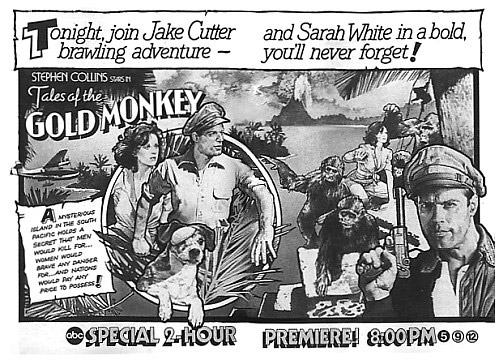
Gold
Monkey
advert
made by Drew Struzan. |
|
Tom Greene:
I have always loved any kind of adventure
that was from another time and place. Somehow
I have never been much for “right now."
In fact, I like to tell people that I only come
back to “reality" as a tourist. Therefore
the idea of a world totally into itself is much
more exciting than the horrid mess we really live
in. That is why I've always been attracted to
Science Fiction and adventure stories, especially
westerns. My father was a writer, and wrote many
adventure stories, and in fact is in the Cowboy
Hall of Fame for his writings. So I grew up with
that. I loved Robert Service from before I can
read, and there wasn't a western I didn't know
by heart after I watched it. My favorite movie
of all time is 2001:
A Space Odyssey, more for how it throws
you into so many worlds of the past and future
(and leaves out the present, in the most amazing
“jump shot" in movie history), and
how it makes you think, and look at your own life
in new and inspiring ways. After Monkey
I made a mini-series called Wildside
with Meg Ryan, Howard Rollins and Will Smith,
which was a western, but frankly was influenced
greatly by Don's writing, especially of Monkey.
It's sort of like the way Disneyland was originally
created. Walt felt that when you went into his
“world" it should be airtight, and
nothing from the outside world should be seen.
He spent hours and hours making sure all “sight
lines" were covered, that is, you couldn't
see anything outside the park, no billboards or
buildings or even mountains. He also sound proofed
the borders so you didn't hear horns or sirens
from the outside, and made a deal with the Orange
County Airport to keep planes and helicopters
from flying over the park. That is how an adventure
should be as well. You should be totally involved
in that world, and a concerted effort by the filmmaker
must be made to keep the “billboards"
out. And those are the ones I love. Probably the
westerns of Sergio Leone, who was a master at
the “air tight" adventure, was one
of my biggest influences growing up.
Adventure stories produced by
Hollywood today seem either inspired by video
games or made to inspire video games. Have there
been any old fashioned adventure films or series
you've seen and admired in the last 20 years?
Tom Greene:
That's a hard one, since you sort of hit the nail
on the head. Adventure movies, especially these
days, are not story driven, they are all CGI driven.
It's all about the effects and has nothing to
do with character or plot. One of the great adventure
writer-director's, John Milius, created some terrific
work and it all came from character, and virtually
no computer generated garbage. When you look at
Troy, or
Alexander the Great, or even Gladiator,
I defy you to tell the difference between each
one, especially in the battle sequence. When you
used to watch Ben Hur
or Spartacus,
or Lawrence
of Arabia, you had a feeling that you were
part of an “event", since you realized
that they really did have 1000s of people on that
field that day. When you saw the famous “fly
over" shot in The
Longest Day, or one shot high-crane battle
of the village in Bridge
Too Far, or for that matter the landing
of the hundreds of paratroopers in Bridge, something
happens inside you, since you know you are part
of an “event". To think that some
geek, high on Jolt and half-watching the Pam Anderson-Tommy
Lee Video while working on his computer, created
the digital soldiers, kills it for you, and there
is no emotional response. Even if you don't know
how they are “stamped out" on a computer
screen, subconsciously there is an emotional disconnect.
It's interesting that Spielberg himself makes
this point in his great interview on the DVD of
Lawrence
of Arabia, and recently he has been quoted
as saying that if he makes another “Indy,"
he will concentrate on “in camera"
effects, and real stunts, and keep the computer
stuff to a minimum. Probably the best adventure
film of the last twenty years was Mountains
on the Moon. A grand mixture of true adventure
with intelligent dialogue, characters and story.
Actually, for me, the best adventures series on
TV are the ones created by Michael Palin in his
true-life travel series. They are the true classic
adventure TV series of the last twenty years.
Again, Michael's own enthusiasm and deep emotions
carry these programs to classic status. I don't
think that drama TV, with its present executive
brain-drain is capable of anything like it.
Harvey Laidman:
A lot of the new shows are so laden with special
and photographic and CGI effects that I can't
seem to identify with the hero. Destination
Moon by Robert Heinlein and George Pal
(1954) is my favorite movie. I liked Tom
Jones and 2001
a Space Odyssey, Dr.
Strangelove and Failsafe.
Oh, whoops! Were some of these made for adults?
Stephen, given that you are also
a published novelist, and Richard Hatch was granted
the rights to work on Battlestar
Galactica novels, I am wondering if you
ever entertained the idea of writing your own
Tales of the Gold Monkey novel.
Stephen Collins:
It never crossed my mind. But I did write a pretty
good script for the show. It's about Jake finding
Amelia Erhardt, who, it turns out, was an old
girlfriend of his. If I thought there were a wide
enough market for a novel, it would be fun to
write it.
Getting back to the show, the
use of voice-over narration and flashbacks are
discouraged in most film circles and yet they
were so effective on Gold
Monkey. Any idea why? I seem to recall
Tom Selleck doing the same on Magnum.
Tom Greene:
Again, you can credit Don with that. He felt that
was a bit of his trademark and an enormous amount
of time was spent both in Magnum
and Monkey
to get them right. Magnum
did, however use them more at times to clear up
plot points, since those shows could get very
convoluted, whereas Monkey
really did use them for self examination and to
create mood and atmosphere. I think that, especially
in Monkey, the
reason they were so effective was because the
nature of the voice-overs had an honesty to them.
They would reveal things about the character you
didn't usually hear, especially from the star
of a TV series. Remember too, that you had Steve
Collins reading them, and there are very few actors
of his caliber around! The other reason they worked
so well, was that, for about 95% of the time,
they were written in the script at the time we
were writing them. Voice-overs are usually created
after the fact, and are used to clear up something
that is confusing, or at least something the executives
think are confusing, so they seem false, forced,
and patronizing. You find yourself a little pissed
that they have to tell you something you were
already thinking. Remember the great key to good
writing is to let the audience think they are
discovering something. If, in a voice-over, you
slam it down their throat like force feeding a
goose for Foie Gras, it rings false. A good case
in point of that is the difference between the
director's cut of Blade
Runner and the studio cut. In the studio
cut, Harrison Ford was forced to go back into
the studio and record all this voice-over to explain
everything. In the director's cut, there is no
voice-over. Look at them both, and you will find
that the power of the director's cut is so much
stronger. And if you watch the director's cut
first, and then the studio version, you'll realize
that you didn't miss anything without the voice-over.
You got it all, and in fact it had much more impact,
especially at the end.
Harvey Laidman:
A voice-over can make the plot easier to
understand, and the viewer feels that the hero
is speaking directly to her/him. I think it's
great.
What's the biggest difference
between Hollywood today and 25 years
ago?

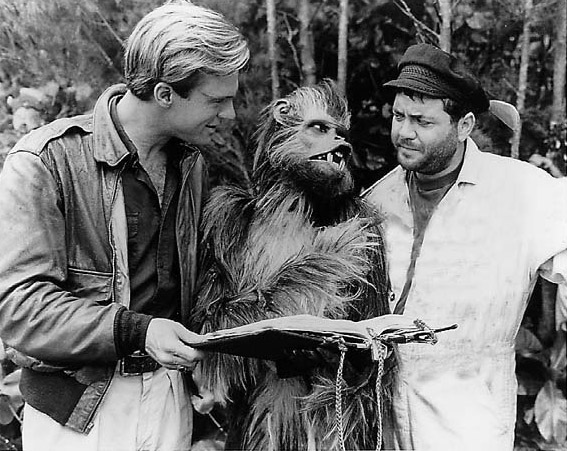
Jake & Corky
with
a big monkey. |
|
Stephen Collins:
Executives don't trust genuine creativity as much
as they used to. They're scared of quirky, real
voices in writing. The blockbuster mentality is
like a virus that has diminished the quality of
the average studio movie. As a result, the audience
has dumbed down. If they made All
The President's Men or Midnight
Cowboy today, they wouldn't find a wide
audience because the studios would be afraid of
them and wouldn't give them a wide release. Ironically,
with cable, there are more original voices working
now in TV than ever before. There's a lot of junk,
but also a number of wonderfully written and acted
shows.
Jeff MacKay:
I think as in most things, Hollywood has become
more and more a commercial enterprise situation
than it was when I started. I know it always was,
but it seems to have become more of a corporate
venture than an undertaking of imagination. Of
course, that's what they told me when I started,
but I really do think that creative decisions
such as those made over the last few decades,
made by uncreative people, is like hiring Rembrandt
and then telling him how to paint. It seems to
me there is no risk taking any more. No room for
it. It's the bottom line that counts. The studios
are run, not by people with ideals, but by number
crunchers who seem much more mercenary than they
once did.
Stephen, what's your favorite
memory from Gold Monkey?
Stephen Collins:
There were three Gooses. One was real and actually
flew and they kept it in Hawaii to shoot the extraordinary
second unit aerial footage, which gave the eventual
scenes inside the Goose a tremendously real look;
a second Goose was on the lake in the back lot
at Universal. It couldn't fly, but it could taxi
on the water. We used that one to film arrivals
and departures at the Monkey Bar dock. The third
Goose was on the sound stage where we filmed the
aerial scenes. Jeff and I spent a lot of time
in that one. It was so difficult to get in and
out of it - a lot of ladders and climbing involved
- that we often stayed inside it while they were
lighting the scenes, instead of getting out and
having stand-ins sit there during the lighting,
which would be the usual way. Jeff and I would
run our lines and just hang out and laugh a lot.
He's one of the funniest people on earth and my
favorite memories are sitting in the cockpit with
him and laughing our heads off. One other great
memory. There was an episode in which Jake and
Corky rode an old motorcycle with a side-car.
I had to practice on it because it was hellishly
difficult to drive. It had what they call a "suicide
clutch" because the clutch was where the
brake would usually be and vice-versa. They were
lighting a scene and Jeff and I just took off
on the bike. We rode all over the Universal lot,
and all through the labyrinths of the back lot.
It was like we'd busted out of school. We'd been
working incredibly long, difficult hours, it was
a gorgeous day, and we were like Tom Sawyer and
Huck Finn. That ride, which probably lasted less
than an hour, was one of the best vacations I
ever took. When we got back, the assistant directors
had flipped out because they had no idea where
we'd gone.
Jeff, favorite memories?
Jeff MacKay:
The moments of delirium at the end of a long day
when we got the giggles. They are always my favorite
moments. Uncontrollable laughter is the best medicine
on the planet for whatever ails you. My friendship
with Stephen was a complete pleasure. The opportunity
to play an unusual character on popular TV was
also a privilege. The cast, the crew, the producers
and the writers all combined to make the show
one big very happy family. I had worked with some
of the crew before, making the daily set experience
a genuine pleasure. They had never seen me do
a character like this before and the gained respect
plus the respect I have for those who are behind
the scenes made it so rewarding for me in so many
ways. These are real people who are doing their
jobs to the best of their abilities. Those crew
members who did not 'fit' into our family were
soon gone. I remember the most affecting scenes
I did in the series include a show called “Cooked
Goose." It's a long story, but the person
who gave me my first professional acting job wrote
the show. We were great friends and when I insisted
that he write a 'spec' script, he wrote one that
had a number of problems. There were, however,
a couple of scenes that were wonderful acting
scenes. He began as an actor and we had worked
in many stage productions together, so he knew
how to write for actors, specifically, me.

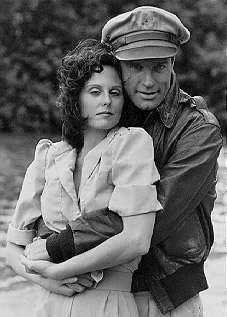
Stephen
Collins with
Caitlin O'Heaney. |
|
Stephen Collins:
Jeff's friend, Jay Huguely's script for
“Cooked Goose" was brilliant, but
show runners don't like to hire outside writers
very often, especially in the first year of a
series. We pushed Don to read it. He could see
that Jay clearly "got" the show; his
script was brilliant and Don, who was exhausted
from doing double duty on our show and Magnum,
saw the value of the script, and hired Jay. Jay
went on to become one of Don's main stable of
writers for many years. It was obvious to me that
Jeff had depth and range as an actor that hadn't
yet seen the light of day. He's so funny that
a lot of people didn't see more than that. But
his performance as Corky could break your heart.
Jeff MacKay: When
Jay submitted the script, the two regular staff
writers on the show thought these two particular
scenes needed to be 'softened' or at least made
to be less dramatic. I read their rewrite and
took the two versions to Steve, and we decided
to make it an issue to restore what my friend
had written. Actorially, they were strong; the
rewrites were watered down. Steve and I prevailed
and the scenes in that episode were restored.
They remain my favorite - selfishly - my
favorites. There were many other scenes that stand
out to me and always they involved Steve. He is
a consummate professional and works with total
humility, so am I. It was always a pleasure and
a privilege to work with him. I'm not surprised
at all that his series
7th Heaven has been on for so many years.
|