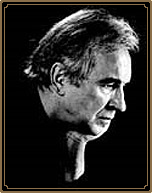
Writing is a risky business.
You must have been pretty sure or loved the thrill
of possibly losing your fedora to get involved.
Can you share with us how you became a writer?
At the age of six I made up my mind
when I heard Dylan Thomas read his poetry on the
radio. I was enchanted by the magic of the words.
I thought: that's for me. I must work with words.
When looking at a bibliography
of your work, the list is pretty extensive. How
do you approach writing a novel?
I get the germ of an idea and start
work. Some writers lay out a whole map of a book,
I don't do that. I like the characters to lead.
I prefer if they have lives of their own. Each
day I only have a rough idea of where the story
is going to take me. Then about 3/4ths of the
way through, I usually see an ending take shape.
Would you share with us some
of the background that charted you along your
current path in writing?
I'm not sure what you mean. I always
wanted to write. I don't know anything else. I
tried most things, but writing was all I ever
needed. I've been lucky to make a living at it.
I was also fortunate in high school in Scotland
because I had a teacher who truly cared about
my writing. He encouraged me. My parents encouraged
me. I was fortunate.
There are currently, over 20
Indiana Jones novels in print. The first, Raiders
of the Lost Ark, is the most sought after.
How did your path into writing lead to your novel
adaptation of Raiders
of the Lost Ark?
My publisher suggested to Lucasfilm
that I do the novelization. They agreed, I agreed.
I hadn't turned a script into a book before. I
was given six weeks in which to do it.
Adam Daniel asks:
Indiana Jones is much more of an enigma in Raiders
of the Lost Ark; his character seems a
little tougher, a little darker. How much freedom
were you given to explore the character in preparing
the novel?

Raiders'
novel cover. |
|
I wrote Jones as I saw him. An adventurer,
yes, but I always felt there was a slight melancholy
side to him. I don't think Lucasfilm really approved
of this, but from my point of view I couldn't
write the novel if I had to base it on the character
in the script - I found him shallow and shadowy,
all action and no thought, and I wanted to add
some kind of internal process to him, which I
think I did. Up to a point. I couldn't write straight
comic book, which was how the script read to me.
Let me give you example that I think suggests
the 'tone' of future Jones's books. In my original
manuscript, I referred to Indiana Jones as Jones
all the way through. The one editorial change
that was made was the change from "Jones"
to "Indy". Clearly, the filmmakers were
thinking of a more approachable more chummy character,
than the darker Jones who appealed to me. They
were right, of course, because they were market-oriented,
and I wasn't. Not to that extent anyway. To me
it seemed to reduce the character to call him
"Indy" instead of "Jones".
How much were George Lucas and
Steven Spielberg involved with your work?
To the best of my knowledge, not
at all.
Adam Daniel asks:
Did Indy's personality seem to change in the film
or its sequels from what you had originally envisioned?
I think he became a caricature,
a comic action hero, and not very interesting
after 'Raiders'. He might have been developed
differently, a more thoughtful character, with
more levels, but I found him being turned into
a hollow Hollywood figure, frankly.
The imagery of Raiders
of the Lost Ark changed cinematic history
and revived the adoration of adventure in print.
Was it difficult to create the places and scenes
used in Raiders?
Did you use anything like props or travel to assist
you?
I invented them myself. I took what
was in the script and added to it. There is a
sequence where Jones travels to Nepal; in the
film this is done with a map. I had to invent
how Jones got there, and I had to imagine what
that trip might be like. There's also the question
of a car Jones gets in Nepal. How does he come
across a car? Is there a Nepal branch of Hertz?
In the film, he just has it: Hollywood magic!
I had to devise a sequence whereby he acquires
a car. There were other such additions to the
book.
Jennifer Feher asks:
When writing about the broken romance between
Indy and Marion, what did you have in mind that
Indy did to "ruin" Marion's life when
she was a teen? I've wondered about this one for
years, so I'm sure others are curious too.
I remember only that she was in
love with him, or had a crush on him, and that
was taboo - she was too young, and he told her
so, and the romance was impossible. If there was
sexual innuendo - an older man's affair with a
young girl - I think that was kept muted. My own
feeling is that they were lovers. He broke it
off. She hurt. But he hurt too, and that interested
me as much as the action: it gives a character
depth if he or she has pain and a past.
Adam Daniels asks:
You describe in detail Indy's past experiences
with Rene Belloq and (especially) Marion -- were
those flourishes you developed on your own, or
were they all "dictated" to you by others?
I had to make them up because there
are gaps in scripts, and in books you can't write
credibly with so much left out in terms of character
development & background. Nothing was 'dictated'
by anyone.
Can you share with us some of
your experiences while writing Raiders
of the Lost Ark?
I don't have many that are illuminating.
I read the script a number of times. I saw where
I'd have to add material to give depth to what
was basically an action screenplay - for example,
some explanation had to be given for Jones's expertise
with a bullwhip. It isn't common for a professor
of archeology to be proficient with a bullwhip,
as far as I know. I had a six week deadline and
I remember deferring work until the last possible
moment. In the end, I wrote and edited the book
in about 4 days. (I should say my wife helped
edit the book.)
Raiders
of the Lost Ark won four Academy
Awards and is now considered an American
classic. Do you feel the book did well? Can you
share with us your opinion about it?
I don't know if the book did well.
I assume it did. I never saw a royalty statement,
nor receive any percentage of sales. I was annoyed
by that because the book went into numerous printings
and whenever I asked for an accounting I wasn't
given one that made any sense. Welcome to Hollywood.
Did you ever consider writing
additional Indiana Jones novels?
No. It was a one-shot thing. The
character doesn't interest me at all any more.
Now that a fourth Indiana Jones
movie is in pre-production and is slated for the
big screens by 2005, if offered the chance, would
you consider writing the adaptation of the final
chapter in Indiana's film life?
No chance.
Adam Daniel asks:
What would you like to see happen with Indy
4, in terms of the story and the character?
The development of a flesh and blood
character instead of the flip comic-book Indiana
Jones we see nowadays. I realize he's popular
as an action hero, but at a great cost to character
development and personal relationships within
the stories.
Do you go to any conventions?
If so, can you give us an idea of where you might
be next?
No conventions. I'm never invited
anyway.
Finally, you've spent an amazing
amount of time devoted to writing. Do you have
any last minute advice for those who wish to pursue
a career in the "risky business" of
writing?
Get a good agent first of all, one
who will stake his/her life on your career. Write
to be read, don't write for a few pebble-eyed
professors in universities. Write to entertain.
Use suspense as a proper literary technique. Watch
people. Keep notebooks. Enjoy yourself when you
can, because it's mainly all damn hard work.
Thank you, so much for spending
time with us. We wish you and yours the best,
and look forward to spending more time with you
by opening a chapter to your latest adventure.
My pleasure. I have happy memories
of writing the book, and some that are not so
happy. But every book is like that.
|