|
|
| |
Indiana
Jones and the Infernal Machine
|
| |

|
Developer:
LucasArts (PC), Factor 5 (N64), HotGen (GBC)
Publisher: LucasArts
(PC, N64), THQ (GBC)
Release date: November 22, 1999 (PC), 2000
(N64), 2001 (GBC)
Project Leader:
Hal Barwood
Written by: Hal Barwood
Original Music by:
Clint Bajakian
Production Manager:
Wayne Cline
Lead Programmer:
Paul D. LeFevre
Lead Level Designer:
Steven Chen
Lead Artist:
William V. Tiller
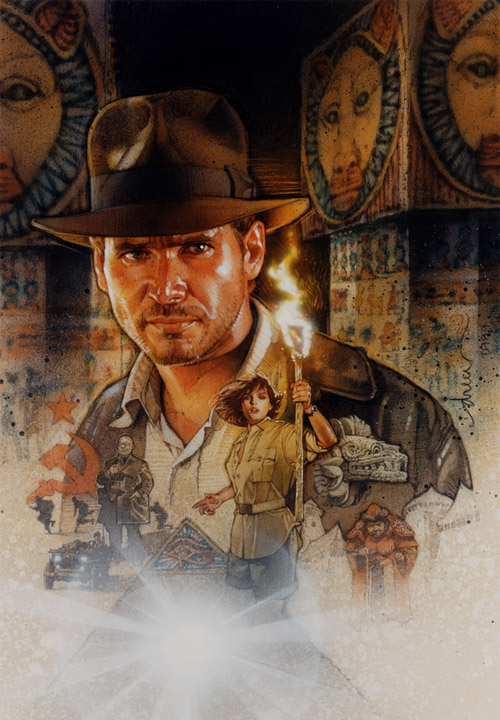
Package illustration
by: Drew Struzan
Voices by:
Doug Lee ... Indiana Jones
Tasia Valenza ... Agent Sophia Hapgood
Victor Raider-Wexler ... Dr. Volodnikov
Bruce McGill ... Agent Simon Turner
|
| Technical Info:
|
| • |
Platforms:
PC Windows,
Nintendo 64, Game Boy Color |
| • |
Genre:
Action/Adventure game |
| • |
Mode(s):
Single-player |
| • |
Engine:
Modified Sith Engine (PC, N64) |
|
| |
After the success
of Indiana
Jones and the Fate of Atlantis, Indy fans
waited in eager anticipation for a sequel. Lucasarts
answered the call with news of a graphic adventure
entitled Indiana Jones
and the Spear of Destiny. These rumors
were short lived and soon, any news of the sequel
disappeared. Indy fans and gaming fans alike could
only wait, much like the Star
Wars fans waiting for news of a new film.
A few years later, LucasArts released Indiana
Jones and His Desktop Adventures and the Super
Nintendo game Indiana
Jones' Greatest Adventures. These games, while
very good in their own right, were hardly sequels
to Fate
of Atlantis.

Box illustration
by Drew Struzan. |
|
In 1996, a company named Eidos released
a revolutionary game that centered on a video
game character who has become more popular than
Super Mario and Sonic the Hedgehog combined. The
game was Tomb Raider
and the character was Lara Croft. The game harnessed
a powerful engine that allowed for the player
to control Lara from a third person perspective
while the virtual camera followed her every move
and moved somewhat independently to add drama
and suspense to this thoroughly engrossing game.
Lara could walk, run, jump, roll, climb, grab,
somersault, and look in all directions. The play
control was simply stellar. The plot of the game
was an Indy fan's dream come true. Lara Croft,
an adventurer and ancient treasure seeker, was
racing the corrupt Natla Corporation across the
world in search of the fabled city of Atlantis
(sound familiar?) and adventured her way through
countless tombs and traps, pulling hidden levers
and running from huge boulders, to find the city
first.
This type of gaming format combined
action and adventure gaming seamlessly. Real time
game play was interwoven with items, levers, and
puzzles. The game became a best seller in 1996
and Lara was seen as the female Indiana Jones.
The game format was perfect for an "Indyesque"
adventure and LucasArts saw the possibilities
as much as the players did. They started development
on Indiana Jones and
the Infernal Machine around the time that
Tomb Raider II hit store shelves, but the game
would go through a series of delays over the next
few years. Luckily, these delays were well worth
it. It is more than likely that the gaming team
at LucasArts was watching the Tomb
Raider franchise carefully and finding
all of the kinks and unused potential to better
develop Infernal Machine.
The game was finally released in
November of 1999, almost the same week as Tomb
Raider: The Last Revelation (a.k.a. Tomb
Raider IV). The ad campaigns for the game
boasted that the original Tomb
Raider was back and ready to take on Lara
Croft. LucasArts even commissioned Drew Struzan
to do artwork for the game to give it that classic
Indiana Jones look and for a limited time, they
released small bullwhips that were sold in blister
cards alongside the game in stores. Additionally,
the game was hyped as the sequel to Fate
of Atlantis. Finally, the sequel had come!
  
Solving puzzles
and Indy's reunion with Sophie. |
|
| |
| |
Story and Gameplay
The story is as follows. It is
the year 1947. World War II has ended and eight
years have passed since the events in Fate
of Atlantis. Indiana Jones is now in the
American Southwest on a traditional archaeological
dig looking for potsherds and generally bored.
Out of the blue, old flame and Fate
of Atlantis veteran Sophia Hapgood appears.
She tells Indy that she is now with the CIA and
working against Communist Russia. She asks Indy
to help her thwart the Russians in obtaining pieces
of an ancient machine that, if rebuilt, could
reach through space and time to new dimensions.
Apparently, this machine was originally housed
within the fabled Tower of Babel, but was scattered
across the world in pieces. The Russians are looking
for the pieces and Indy must beat them to punch.
From there, a truly wonderful game
begins. The style of the game is exactly the same
as the Tomb Raider
series with one added bonus: You play as Indiana
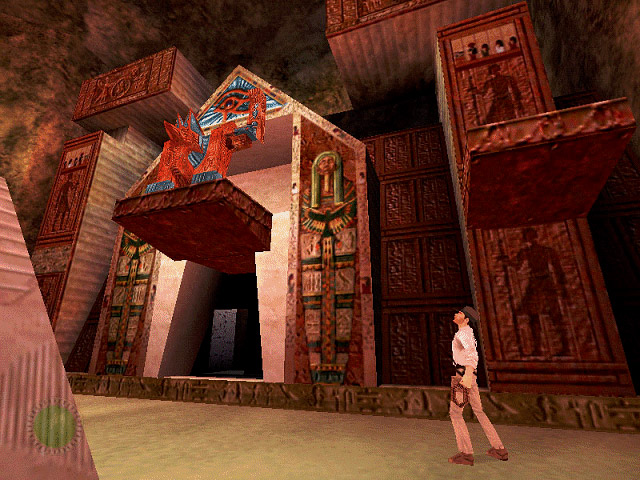
Jones. The graphics are crisp and well rendered
and Indy looks better than he ever has in a video
game. The detail LucasArts put into Indy is really
impeccable. His shirt has the proper pleats, and
his hat even turns up slightly at the brim sides
just like the fedora in the films. The play control
is excellent and easy to get the hang of. The
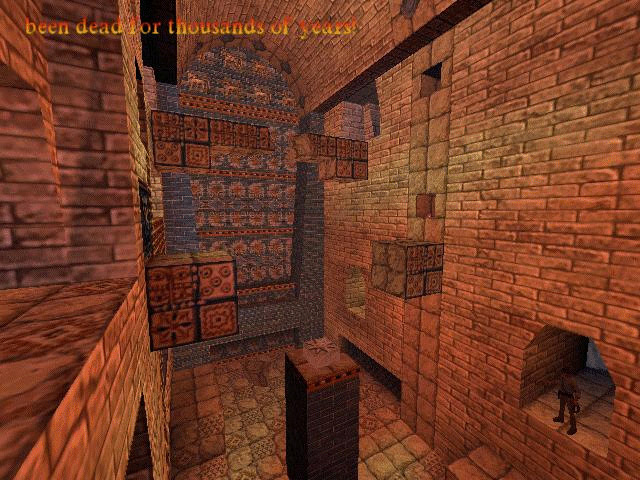
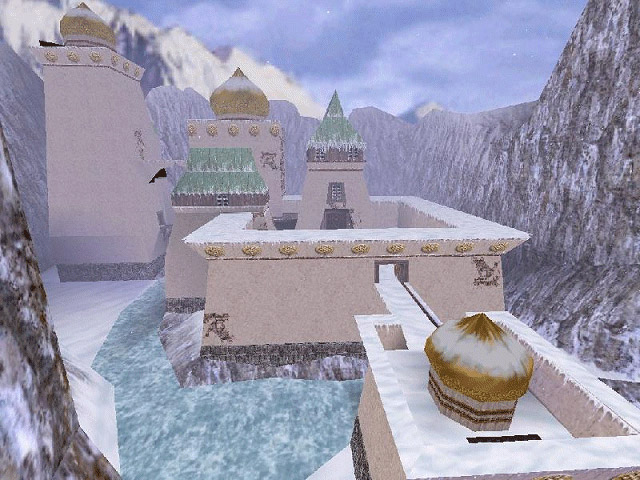
levels are beautifully designed, varied, and challenging.
Indy explores pyramids, temples, Russian boats,
and caves searching for the Infernal Machine.
The Russians make worthy successors to the Nazis
as formidable enemies for Indy to thwart. A good
dose of disgruntled wildlife is thrown in as well
to keep Indy on his toes, including scorpions,
sharks, and… Snakes.
  
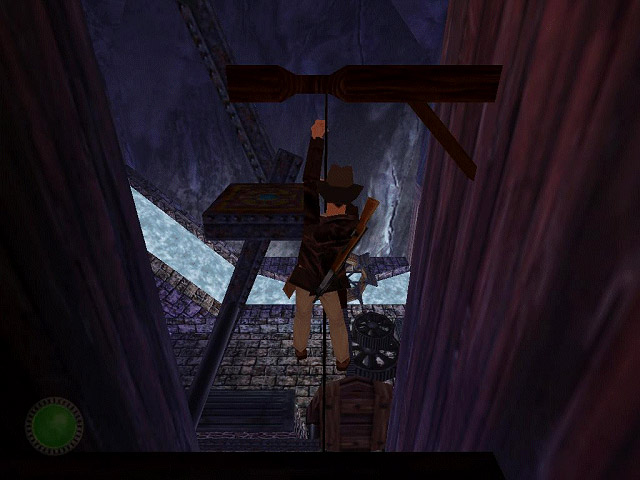
Indy literally
travels around the globe in this adventure. |
|
| |
| |
Conclusion
When I first got my hands on this
game I was so afraid that the game would copy
Tomb Raider too
closely and there would not be any Indiana Jones
spirit in the game, but I could not have been
more wrong. It is very obvious that LucasArts
was extremely meticulous in preserving Indiana
Jones' character throughout the game. John Williams'
Raiders' March plays at all the right moments,
I believe that the voice of Indy is the same actor
from Fate
of Atlantis (which provides a sense of continuity),
and Indy himself is not Lara Croft with a new
mold. To be more specific, Indy doesn't run or
jump like Lara Croft. Indy runs, well, like Indy!
When you play the game, you really
feel like you are Indy because the developers
took the time to inject the character from the
films into the game. Unlike Lara Croft, when Indy
jumps a ravine, he is not graceful. He jumps like
he did in Raiders of
the Lost Ark when Satipo refused to throw
him the whip. When he whips a swing post, he looks
just like he did in the Temple
of Doom. LucasArts really studied Harrison
Ford's physical acting when they rendered this
sprite. Whereas Lara Croft relies exclusively
on her guns for defense, Indy has his whip (which
can disarm enemies), his Smith and Wesson, and
his trusty fists should he encounter an unarmed
opponent. Naturally there are a whole slew of
other weapons to obtain as well. Also, the "Indy
Quotient" returns in this game to give you
a solid idea of how many secrets you found, how
well you played the levels, or resolved conflicts.
The game is very engaging, with
all of the Indy problems to overcome. You must
traverse deep caves, dangerous trap-laden temples,
and sometimes survive in the treacherous outdoors,
with the Russians on your heels the entire time.
The story is very well done and very worthy as
an Indiana Jones adventure, but the game does
have its drawbacks, mostly minor but existent
nonetheless. Most of the criticisms I have of
the game are ones of style. For example, it becomes
very tiring to hear Indy exclaim "Ah ha!
An idol!" every single time you find one.
Also, for Indy to find a key, open the door with
the key, and say, "I'll be damned. It opened!"
makes him seem like a simpleton. The other small
peeve I have with the game's style is the fact
that Indy runs around without his jacket way too
much. Almost ninety percent of the levels have
Indy "jacketless" which, while being
a small problem, bothered me all the same.
The game has other issues as well.
For starters, what is the point of using the whip
to disarm someone if they always get a few good
deadly shots off before you can use it? It's better
to use a gun before they do because there is no
option in this game to talk your way out of a
fight. As a result the whip and the fists become
useless as weapons. Another problem I have with
the game is the return of Sophia Hapgood. Why?
Because every Indy adventure usually introduced
a new heroine. That is what made Fate
of Atlantis so fun because it was not Marion
or Willie being recycled. It's not a big problem,
but it would have been nice to introduce a new
character. My biggest problem with the game ultimately
was the entire third act of the story and the
ending, but I am not one to give things away,
so I'll say no more about that.
Overall, Indiana
Jones and the Infernal Machine is an excellent
game with wonderful play control, beautiful graphics,
and bucket loads of Indiana Jones adventuring
to enjoy. This is easily, in my opinion, the second
best Indy game ever made with Fate
of Atlantis winning the top spot by a small
margin. It is certainly worth playing and every
Indy fan who likes gaming should experience it.
The game is currently available for the PC and
N64, the latter of which has improved play control
but slightly muddier graphics. A version for the
GameBoy has been released as well. Get cracking.
(MF)
  
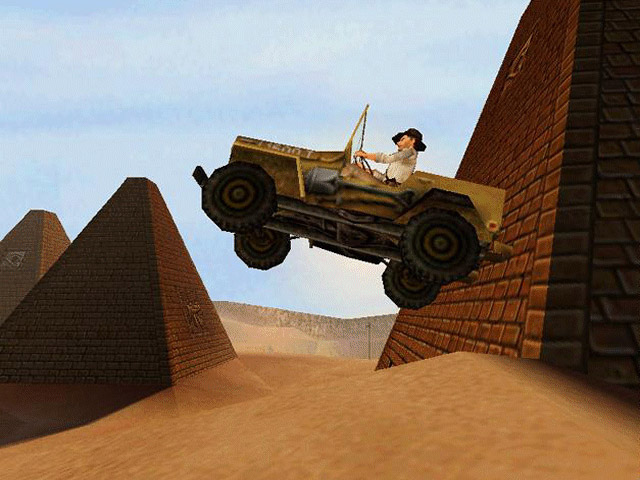
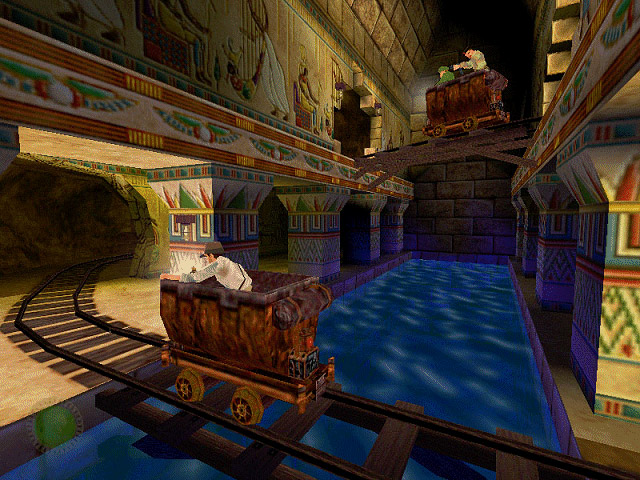
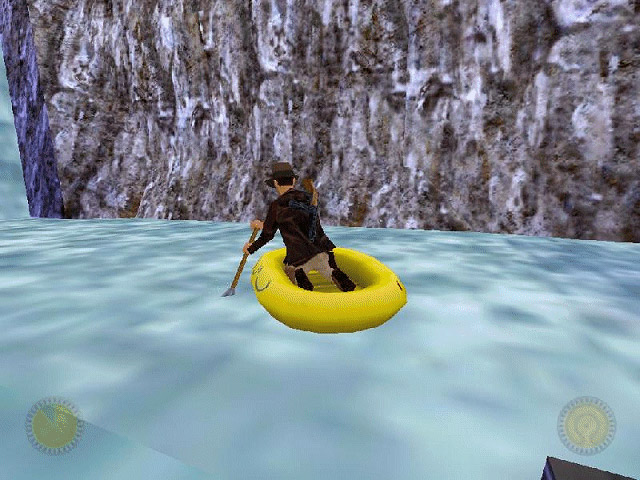
Jeep driving,
mine cart and raft riding, you get to do it
all. |
|
| |
| |
Levels
| • |
Canyonlands |
| • |
Babylon |
| • |
Tian Shan River |
| • |
Shambala Sanctuary |
| • |
Palawan Lagoon |
| • |
Palawan Volcano |
| • |
Palawan Temple |
| • |
Jeep Trek |
| • |
Teotihuacan |
| • |
Olmec Valley |
| • |
V.I. Pudovkin |
| • |
Meroe Pyramids |
| • |
King Solomon's
Mines |
| • |
Nub's Tomb |
| • |
Infernal Machine |
| • |
Aetherium |
| • |
Return to Peru
(Bonus Level) |
|
| |
| |
References & In-Jokes
| • |
On the map showing
Indy's journey to Teotihuacan, both Melee
Island from Secret
of Monkey Island, and El Marrow from
Grim Fandango
can be seen. Both are adventure games also
made by LucasArts. |
| • |
Hidden
Room #1: After Indy picks up the
"Tool From Beyond" in the final
chapter, a hole can be found at the bottom
of one of the tunnels. This hole is the
entrance to a 3D version of the Barbary
Coast from LucasArts' Curse
of Monkey Island. When looking around
the room you'll also find photos of Steven
Spielberg, George Lucas, Indiana Jones,
a Raiders
ghost and Jar-Jar Binks on the walls. |
| • |
Hidden
Chapter: After completing the game
you can play a bonus level called "Return
to Peru". In this level you return
to the location and explore the cave from
the opening scene of Raiders
of the Lost Ark again. |
| • |
Hidden
Room #2: The bonus "Return to
Peru" level hides a second hidden room
that can be found after whipping the Stone
Head. Once the head falls and dislodged
the giant boulder, go back and return to
the Snake Cavern where you can now jump
and climb to where the boulder once was.
There you'll find a room on the right with
five switches. Press the switches in this
order - 4 5 3 1 2 - and you'll hear John
Williams' famous Close
Encounters of the Third Kind chimes.
A door will open and you'll be able to enter
a comfy room with a model of Devils Tower
on a table. A reference to Steven Spielberg's
Close Encounters
of the Third Kind. |
|
|
|
|
|