| Chapter 4b
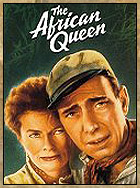
The
African Queen with
Hepburn and Bogart. |
|
Okay, quit monkeyin' around, here's
the story so far on Indy 3 - not the one you saw
at the cinema, but the one you DIDN'T see, scripted
by Harry Potter
director Chris Columbus at the dawn of his career.
In a rip-roaring tribute to The
African Queen, Bringing Up Baby, and various
Grade-Z jungle comedies from the 1930's, Columbus
sent Indy and assorted sidekicks to Africa. His
quest is to find the legendary half-man, half-monkey
King Sun Wu-Kung, his lost 'City in the Clouds',
(no relation to Bespin) and his Garden of Immortal
Peaches, which, err, give immortality. Indy's
adversaries are Nazis, and along the way he takes
part in a thrilling speedboat chase in a Mozambique
dock, a fight with river pirates, and encounters
various jungle traps, lions, scorpions, cannibals,
and more. Eventually they and the cannibals join
forces to dig a giant pit in which to hide from
a stampeding herd of wildebeest. When the stampede
passes we discover what caused it - a giant tank,
driven by the pursuing Nazi goons.
Just as the speedboat chase found
its way into Last Crusade, but in a much
inferior form to the way Columbus scripted it,
so the tank sequence in Last Crusade is
a pale reflection of how it appears in the Monkey
King script. Columbus imagines a vast super-tank
'TEN TIMES the size of a normal tank. Nearly 100
FEET LONG. Over 25 FEET WIDE'. Okay, so perhaps
having a Nazi tank be the size of a AT-AT is a
little unrealistic, but still, it would have been
an incredible sight on the screen. Indy and friends
run to escape it across the African plain, but
Indy trips over and then gets up, only to be chased
by a... rhinoceros.
As if a giant Nazi tank wasn't enough.
Indy somehow manages to get onto the rhino, by
running in a circle and narrowing the circle lap
by lap until he is alongside the animal - then
leaping onto it and riding it. And no, you can
read this paragraph in the script over and over
again, and it still won't make sense or be any
more plausible. The rhino spots the tank and being
short-sighted mistakes it for a giant rhino -
and attacks. Indy manages to scramble on (jumping
from a horse to a truck seems fairly easy by comparison).
Meanwhile Indy's friends (an African called Scraggy,
his love interest Dr. Clarke, a river pirate called
Kezure, and an annoying female student called
Betsy) are being pursued by the tank, but have
come to a ravine. With no way out they climb up
into a tall tree ("Scraggy: Safest place
from bad spirits is in the branches of tree...")
but the Nazis take aim. Indy jams the gun barrel
with a headlamp and the gun backfires, killing
some of the Nazis. A furious fight then begins,
like the one in Last Crusade - only better!
- while the tree holding Indy's friends teeters
over the edge of the ravine, and the driverless
tank heads towards the tree. Columbus has a knack
of writing action sequences like this, well-choreographed
with a number of different elements in play, totally
absurd and fantastical but with an internal logic
which saves them from our scorn (the rhino episode
aside). He also likes to heap trouble on top of
trouble - as if the tank battle wasn't enough
a Nazi biplane suddenly appears and begins to
strafe the tank! Indy gets a hold of Gutterbuhg,
a Nazi with a machine gun in his mechanical arm,
aims it at the biplane and shoots it down. He
then knocks out the Nazi, leaps into the tank's
cabin, and brings it to a halt.
Earlier, Gutterbuhg had kidnapped
Tyki, a pygmy from the lost Cloud City. They release
him, and Indy radios Gutterbuhg's boss, the 'Nazi
nightmare' Lieutenant Mephisto, taunting him with
the Nazi's failure. This is a mistake; as Mephisto
informs Indy, he has a whole army at his command,
and 'the battle has only just begun'. They set
off again, with Tyki guiding them to the specific
mountain on which the clouds shrouding its peak
carry the Cloud City of Sun Wu-Kung. Indy drives
the tank with difficulty up the steep mountain
path, until they reach a point two miles from
the Cloud City - and suddenly see the Nazi forces
in pursuit! Indy uses the tank's guns to cause
a landslide which blocks Mephisto's path, and
drives on up into the clouds, but now the tank
itself is attacked, not by the Nazis, but by giant
gorillas, hurling enormous boulders. The sequence
is a great piece of writing, and would have been
very atmospheric on screen:
INT. TANK
Indiana looks through the periscope.
His view blinded by the clouds.
EXT. MOUNTAIN
The tank is a large, gray blur
through the clouds. Several dark, bulking
figures appear! They climb along the ravine
sides and tops. The mysterious figures surround
the tank. All are holding enormous boulders
over their heads. Aimed at the tank.
INT. TANK
Indy eases up on the gas. The
tank slows. Suddenly, there is a loud crash!
The tank is hit. Rattling. shaking. Everyone
is tossed. Save for Indy, who stays at the
controls. He continues to guide the tank forward.
There is another crash. And another. And another.
EXT. MOUNTAIN
The dark figures shower the
tank with heavy boulders. The tank's gun barrel
snaps in two. Headlights smash. Its body becomes
dented. Cracked.
INT. TANK
Indiana is tough. Persistent.
He continues to move the jolting tank forward.
As the surrounding walls cave in. Shatter.
Everyone panics. Screaming.
EXT. MOUNTAIN
The injured, wobbling tank moves
out of the clouds. Arriving around the corner
from the mountain top. The countless dark
figures continue to follow the tank. Scurrying
along the ravine sides and tops. The figures
emerge from the clouds. For the first time,
they are visible. And we see that the figures
are tall... hairy... muscular... Gorillas!
They continue to assault the tank with boulders.
The tank breaks down, and Indy has
no choice but to get out and see what is happening.
The giant gorilla's toss him around like a plaything,
taking off his hat, jacket and whip, and dressing
up one of their own kind as Indy. They then make
to throw him off the mountain's edge, but before
they do so Tyki, (who, being from the Cloud City,
obviously speaks fluent Gorilla) commands them
to put him down. This would have been a great
sequence, but it is difficult to see how it would
have been done effectively in the mid-Eighties;
it seems about fifteen years ahead of its time.
Now, with CGI, it could be done without too much
trouble. The gorillas give Indy his stuff back,
having dented only his pride, and lead the group
up into the Lost City:
Tyki continues to shoot orders
to the other Gorillas. The pygmy suddenly
appears strong. Authoritative. He obviously
has power over the beasts. The Gorillas gather
together. They move toward the people. The
apes gently take the hands of the various
humans. It is a warm, enchanting sight, as
the friendly Gorillas lead the humans forward.
Clare, using her Gorilla motions and sounds,
communicates with the beasts. The group moves
around a twisting corner of the path. Toward
the mountain top.
AROUND THE CORNER
Indiana and the others are met
with an awesome sight! Indy stops. His mouth
drops open. Clare is equally astounded. Betsy
and the others stare ahead. In total wonderment.
Even Gutterbuhg is amazed. The soundtrack
music explodes into a thundering crescendo!
THE LOST CITY OF SUN WU-KUNG
Lies ahead of the group. A spectacular
sight! A city whose every building and tower
is cast in solid gold! Sparkling! Glistening!
A heavenly place. The City is protected by
a deep moat. The fins of several sharks
move through the moat waters. A thick stone
wall surrounds the city. A large, golden drawbridge
is built into the wall. Passageway into the
city.
They enter the city, and the Guard
at the gate begins to shout, in Tyki's language,
"Our Prince has returned home". The
city itself is a magical place, suffused with
a golden light - the streets are literally paved
with gold - and bursting with the bright colors
of exotic fruits and plants in beautiful gardens,
crystal lakes, and other wonders. Indy and friends
are taken to meet the city's ruler, Bohbala, who
is also Tyki's father, and he welcomes them to
stay for as long as they wish. But at that moment,
disaster strikes. During the tank battle, Indy
had removed the bullet clip from Gutterbuhg's
mechanical gun-arm. Now Gutterbuhg removes a spare
bullet he has had hidden in his mouth, inserts
it into his gun arm and shoots Bohbala dead. But
worse is to come. As Indy attacks Gutterbuhg he
is prevented from doing so by the palace guards,
and then everyone turns and kneels before the
Nazi. A distraught Tyki explains that 'when a
ruler is defeated by a greater power, he who possesses
that power... shall become ruler!'. And as an
exultant Gutterbuhg raises his mechanical arm
in a 'Hail Hitler' salute, the entire city imitates
him.
Indy's friends are dragged off to
the Palace dungeons (dungeons? In this supposedly
perfect society?) while Gutterbuhg tells Indy
that when Mephisto and the Nazi army reaches them
they will slaughter the inhabitants and take the
city apart for its gold - and to find the Garden
of Immortal Peaches, so that the Fuhrer can live
as long as his 'thousand year' Reich. The action
cuts to the Coliseum of the Lost City, an enormous
stone arena. Indy is brought shirtless into the
vast arena, as Gutterbuhg sits watching in the
elaborate ruler's box, which is covered with a
protective gold grating. Indy is tied between
two enormous buffalo, ready to be ripped apart;
his friends are suspended in a large metal cage
over a deep pit filled with ferocious tigers.
Just as Gutterbuhg is about to give the order
to release the buffalo, Indy screams 'Hail Hitler!'
and Gutterbuhg reflexively raises his mechanical
arm in a Nazi salute, catching his fingers in
the grating. It gets stuck, and as he tries to
pull it out, his arm comes away from his socket.
Indy's friend Scraggy (who Gutterbuhg had forced
to act as his translator) grabs the arm and holds
it above his head. Now he possesses the power,
and is acclaimed as the new ruler by the crowd
in the arena. Scraggy gives orders for Indiana
to be untied, while Gutterbuhg flees the arena,
pursued by the crowd. Scraggy gives the arm to
Tyki, who is cheered as the new rightful ruler.
Meanwhile Gutterbuhg escapes from the city and
catches up with Mephisto and the Nazis, who blast
their way through the landslide and begin to move
on the Lost City.
Readers who are also Star Wars
fans, and make a point of avoiding spoilers, might
like to skip this paragraph. The scene in the
arena is far-fetched even by the standards of
this script, and has no internal consistency with
the character of the Cloud City people as we know
them. How can their civilization be so wonderful
if they allow their leaders to rule only by right
of conquest and are happy to watch barbaric games
and executions in a Roman-style arena? The scene
is of interest to Star Wars fans however,
given the recent revelations about certain scenes
in Star Wars: Episode 2. We know that there
will be a climactic battle in an alien arena,
with action taking place both in the 'royal box'
and on the arena floor, and involving ferocious
new creatures known as 'Reeks'. Obi-Wan Kenobi
will be tied to a pillar, to be killed by the
Reeks, much as Indy is here, but he will be rescued
by the Jedi. George Lucas is known for being as
careful with ideas as he is with his money, and
it is at least possible that while he couldn't
find a home for an 'arena scene' in the Indiana
Jones series, he remembered it when writing Episode
2 and transplanted it into the Star Wars
saga.
As the Nazi attack begins, Indy
gives a rousing speech to the Cloud City dwellers,
pygmies who are armed only with bows and arrows,
spears and blow pipes. In the (intentionally?)
funny speech he tells a story of 'a little guy...
a scrawny runt' who wanted to be in the football
team, but 'the big guys made his life miserable...
always shoving his head in the drinking fountain...
putting mustard in his pants... throwing me...
err, HIM!... in the shower with all his clothes
on'. But, he goes on, Indy - that is, the little
guy - didn't quit, and became the star of the
football team:
(Music rises, so
does Indy's voice)
'Cause that little kid had something
that those big guys never heard
of... He had heart! And nothing can
stop that! Nothing'!
(we hear the Nazis approaching, Indy screams)
Now let's go out there and show 'em
JUST HOW TOUGH THE LITTLE GUYS ARE!
Everyone breaks into
a loud cheer. Ready to fight.
The sound track music soars. Indiana raises his
sword.
He turns and runs toward the drawbridge.
The people follow, as Indy leads them into battle!
A huge (and well-choreographed)
battle begins, involving pygmies, pirates, birds,
gorillas, Nazis, Ewoks, Gungans (no, scratch those
last two!) and a private battle between Indy and
Gutterbuhg, who has acquired a new mechanical
arm, one that shoots bolts of electricity! The
Nazis plant a huge pile of dynamite in the city,
intending to destroy it, and the fuse is suspense
fully lit, put out, and relit a number of times
before Indy puts it out, seconds from disaster,
with his bullwhip. Gutterbuhg is finally tricked
into electrocuting himself on a lake (shades of
the Bond villain Oddjob in Goldfinger).
Then Indy goes after the Nazi leader Mephisto.
They go back into the arena, and have a fight
over the tiger pit which ends with Mephisto falling
into it... but not before he has shot Indy in
the chest. Indy staggers out, then falls to the
ground and - dies!?!
Outside the battle has ended with
the Nazis defeated but many of the pygmies are
dead also. Indy's limp body is carried out of
the arena, to the grief of everyone present, and
the entire city gathers around it. That night
an elaborate funeral procession takes place. It
doesn't seem right somehow merely to paraphrase
an account of Indiana Jones's funeral, so here
it is in full:
CLOSE-UP: INDIANA'S BODY.
It is lying in state. Resting
on a bamboo stretcher. It is covered with exotic,
colorful flowers. CAMERA PULLS BACK. Indy is
being carried by several, elaborately dressed
pygmies. At the head of a long funeral procession.
Betsy, Clare, Scraggy and Kezure march beside
Indy's body. They also wear the ceremonial funeral
flowers. Behind them, the body of Bohbala is
being carried. And behind the ruler, the bodies
of all dead pygmies are being carried by the
remaining villagers and Gorillas. It is nighttime.
All mourners are carrying flickering candles.
At the rear of the procession, a lone pygmy
strums an unusual strong instrument. This creates
a haunting melody.
CAMERA PULLS BACK TO A LONG SHOT,
as we see the procession move through the city.
The hundreds of flickering candles against the
dark night sky create a beautiful image. The
procession arrives at a large stone wall. It
appears to be a dead end. Tyki walks to the
wall.
He falls to his knees and begins
to chant. Clare, Betsy, Scraggy and Kezure watch.
There is a small rumble. A hairline crack begins
to form in the mountain. As if it were being
drawn by an invisible hand, the crack forms
a large door in the wall. The door slowly opens.
An almost blinding white light emanates from
inside. Tyki enters. The procession follows.
All mythical heroes, from Odysseus
onwards (and probably before), have this in common;
they visit the underworld, the lands of the dead.
Indiana Jones is certainly a mythical hero, from
his outfit (which is basically American national
costume - the cowboy outfit) to the quests which
he undertakes, to defeat evil and increase his
tribe's knowledge of the world and its powers,
both natural and supernatural. The Star Wars
saga will be deficient as a modern mythology if
Anakin Skywalker does not perform a similar journey
in Episodes 2 or 3. It is a shame that Monkey
King was never filmed, so that Indy could
perform a journey made by heroic archetypes since
the dawn of storytelling. Maybe Indy 4...?
Anyway, on to the important stuff;
just how does Indy manage to get out of being
dead? Tune in next week... no, I wouldn't be so
cruel. The funeral procession enters the blinding
light and ascends a twisting stone staircase,
spiraling upward where the light becomes brighter
and brighter. At the top there is another doorway
and the procession goes through it to enter the
Garden of Immortal Peaches. This is a 'breathtakingly
beautiful forest of never ending luscious green
trees, filled with succulent, ripe peaches', a
magical and intense place, where the sun shines
even in the middle of the night. They proceed
to a clearing where the bodies, including those
of Indy and Bohbala, are placed in freshly dug
graves. Before them is a huge tree which has a
small, glass encased tomb built into its side,
and inside it is a tiny skeleton, no more than
four feet tall, adorned with a lion skinned robe
and a golden crown. In its hand is an elaborate
staff, the 'Golden Hooped Rod' of legend.
The pygmies begin to lower the bodies
into the ground and at that moment there is a
rumbling sound and a tremor; a howling wind fills
the Garden, and the tomb of Sun Wu-Kung glows
with a bright light. The glass surrounding the
tomb suddenly shatters, and, unbelievably, the
skeleton steps out of the tomb. It screeches and
an 'ectoplasmic green smoke' leaves its fingers,
traveling over the human's heads to the gorilla's,
and encircling their bodies, then lifting them
in to the air, carrying them towards the skeleton...
and as they draw close, the gorilla's shrink,
becoming tiny hair like substances that attach
themselves to the skeleton's body, then become
individual hairs, until finally the skeleton is
transformed into Sun Wu-Kung! He is half-human,
half-monkey, with a 'devilish, but charming smile'...
a 'heavenly figure'. He shouts up into the heavens:
SUN WU KUNG
We cannot bury these men!... This is a garden
of life...
Not of death!...
And he demands that Heaven 'returns
their souls'. A few moments pass, then a thick
white cloud eclipses the sun, allowing only a
single ray of light to shine on one of the peach
trees... Peaches fly from its boughs into the
graves, and as each fruit hits the dead men it
bursts and they begin to wake and climb out of
their graves, their wounds healed, their lives
restored. Indy too stands, completely bewildered,
and his friends rush to embrace him. He speaks
with the Monkey King, who, to his astonishment,
knows his name - then tells Indy that he has been
following his career from the heavens. He thanks
him for saving his city, and as a sign of appreciation
gives him his Golden Hooped Rod, a priceless artifact,
and more - as we discover at the very end of the
film. With his city safe, the soul of the Monkey-King
returns to the heavens, while his body, now just
a skeleton again, returns to its tomb. Meanwhile
Kezure the Pirate King has been busily stuffing
his pockets with peaches...
The following morning Indy and his
companions leave the city, but on the mountain
path down Kezure double crosses them - he and
his men steal the Golden Hooped Rod and are about
to kill Indy when Kezure, beginning to eat one
of the peaches, suffers the same fate as Donovan
would in Last Crusade, ageing rapidly until
he crumbles to dust. His men run off. As Indy
explains, the peaches promise immortality, but
only to those who are pure of heart.
At Mozambique Indy catches a liner
home, alone; romantically he has no luck at all
in this script. But he leaves the Golden Hooped
rod behind on the dock side! Clare takes it back
with her for safe keeping. That night we see the
crate holding the Golden Hooped Rod in her room;
the box's nails begin to turn as if being twisted
by invisible hands and drop to the floor. In a
triumphant re-modeling of the scene in Raiders
where the Nazi insignia on the side of the Ark
crate is burned off, the crate opens and the Golden
Hooped Rod, shimmering in the moonlight, emerges
from the box transformed into a Golden Eagle!
It flies out through the window as Clare continues
to sleep peacefully. As Indy's liner sails across
the wide ocean the Golden Eagle flies in through
his cabin porthole, and the sleeping Indy wakes
just as the Golden Eagle transforms itself back
into the Golden Hooped Rod:
The rod leans against the wall.
The moonlight reflects the rod, shining into
Indiana's eyes. Indy wakes. He sits up and sees
the Golden Hooped Rod. At first, he is shocked.
He touches the rod... then comes upon a realization.
The creaky voice of Sun Wu Kung fills the soundtrack.
SUN WU KUNG (V.O.)
The Golden Hooped Rod will be a
faithful friend. It is capable of
one hundred transformations... and
will always remain by your side.
Indy stands. He turns and looks
out of the porthole. A dreamy... satisfied smile
covers Indy's face, as he stares at the stars
above. SOUND TRACK MUSIC SOARS. CAMERA PULLS
BACK, TO EXTREMELY
LONG SHOT of the ship sailing across the ocean.
THE END
What do we make of the climax in
the Garden and the script as a whole? The scenes
in the Garden are as audacious in their own way
as the opening of the Ark was in Raiders of
the Lost Ark, but with a positive rather than
destructive force emerging into the 'real world'.
Certainly there has been nothing like them anywhere
else, and if the reader finds them laughable,
the script takes itself seriously. There is no
self-parody here. The whole scene is fantastic,
but it requires no more suspension of disbelief
then anything else in the Indiana Jones series.
The only difference is that it's slower paced
than the pyrotechnics at the end of the Raiders,
(it literally borrows its pace from a funeral
procession) and for this reason perhaps may not
have worked - audiences would have had too much
time to reflect upon the scene. But then, the
ending of the Last Crusade slows down considerably
too, once Indy finds the Grail, although at least
there we have the tension of the threat from Donovan
and the life ebbing out of Indy's dad.
Why wasn't Monkey King made?
There were a number of reasons why the script
was never produced, aside from the obvious ones,
like it would have cost $150 million and been
over three hours long. The first and most important
is the response of critics towards Temple of
Doom, many of whom accused it of racial stereotyping,
being patronizing towards other races and creeds,
and promoting a colonial mentality. I mentioned
something about this in the chapter of this article
devoted to Temple of Doom, and will say
more in the final chapter, where I propose to
appear as defense counsel for Indy against all
his critics, ever!!! Leaving aside the validity
of the criticisms, Spielberg and Lucas knew that
Indy 3 could not show foreigners (unless they
were Europeans) as being in any way evil, stupid,
or primitive. And to be fair, parts of the script
are fairly patronizing towards Africans, in particular
through the 'childlike' Scraggy. But even rewritten,
the script simply could not contain 'native peoples'
in it of any kind, so sensitive had critics become
to stereotyping. Any criticism of Indy 3 on similar
grounds to the criticism leveled at Temple
of Doom would have been extremely damaging
to Lucas and Spielberg personally. Spielberg was
particularly cautious as he had just embarked
on a new career of making 'grown-up' pictures,
like The Color Purple, whose central theme
is racial injustice. Spielberg's new found 'grown-up'
side was the other major reason why the script
was never made. As he said when the Last Crusade
was released:
"It [the Monkey King script]
was upbeat and full of the same nostalgia that
we tapped into in Raiders of the Lost Ark
- so in that sense Chris [Columbus] was right
on the money. But I don't think any of us wanted
to go to Africa for four months and try to get
Indy to ride a rhinoceros in a multi-vehicular
chase... Once I got into the script, I began
to feel very old - too old to direct it, anyway."
At this point in his career Spielberg
had convinced himself that to be taken seriously
as a filmmaker, by his peers (and more importantly,
the Oscar Academy) he had to make the kind of
film that generally won Oscars - stirring, usually
historical pictures with issue-led narratives,
about men and women triumphing over something.
He handed the making of 'popcorn' entertainment
films over to directors like Joe Dante and Robert
Zemeckis, and between 1985 and 1987 concentrated
on making 'grown-up' films. Spielberg's cinematic
master, Hitchcock, had taken an 'inferior' cinematic
genre, the thriller, and turned it into a subtle,
complex form capable of harboring great psychological
insight. Spielberg did not try to do anything
similar with the kind of film he was known for
making, but instead tried to give the critics
what he thought they wanted. Not until the early
1990's did he realize that an exploitative costume
drama like Schindler's List could be made
alongside a film like Jurassic Park, rich
in ambiguity and the interplay of ideas.
After the Columbus script had been
placed on the shelf, Lucas began to look at a
story involving the Holy Grail. One problem was
that the Holy Grail, the Cup of Christ, is essentially
a mythological object, and no one had actually
defined what it does before. Lucas added the notion
of immortality, prompted by the Columbus script,
and thus giving the Nazis a particular reason
to go after it, just as they had gone after the
Lost Ark. He also invented the notion that a sip
from the 'false Grail' would age the drinker into
dust (again, borrowed from Kezure's fate in the
Monkey King script).
Having established an object for
Indy to chase, the bad guys were quickly decided
upon. They had to be the Nazis, because the film
had to avoid casting any non-European ethnic grouping
in a negative light. For settings, Lucas went
back to a desert environment, the Republic of
Hatay, which was safely reminiscent of Raiders.
Lucas thrashed out a script with Spielberg collaborator
Menno Meyjes which established the basic storyline,
reusing a number of action sequences from the
Columbus script (although these had probably been
Lucas's idea in the first place). A final draft
screenplay was then written by Jeffrey Boam, with
Meyjes receiving a story credit.
Both Spielberg and Lucas take credit
for the notion of having Indy search for his father
in the film. Spielberg makes contradictory statements
about it, saying on the one hand that the first
draft featured Indy's father being rescued only
at the very end of the script, and that he insisted
Indy's father appear half-way through. On the
other hand he claims to have come up with the
whole idea in the first place - in which case
why did he not have Indy's father appear earlier
in the first draft? Jeffrey Boam claimed the idea
was Lucas's , saying that the idea of a 'search
for a father' is much more characteristic of Lucas's
work than Spielberg's. However, this isn't really
true; one of the main themes in, for example,
E.T. is that of the absent father. The
truth is probably that while Lucas came up with
the idea, Spielberg really developed it. It is
obvious from what he said on the subject that
the idea of Indy searching for his father really
caught his imagination:
"I did not want Indy on a
headlong pursuit without a subplot that was
almost stronger than the actual quest itself.
So I came up with the father-son story because
the Grail is symbolic of finding the truth in
one's life - the truth we are always looking
for, consciously or unconsciously. For me that
was represented by Indy and Henry meeting. In
this context, the Grail made sense to me. They
actually go after the Holy Grail, but their
quest is also symbolic of their search for each
other."
Fatherhood was very much on Spielberg's
mind at that time. Himself the product of a broken
home, his own marriage had broken up, affecting
his children. The Last Crusade gave Spielberg
the perfect opportunity to take a break from 'serious
filmmaking', but at the same time explore important
personal issues.
Last Crusade had a mixed
response from fans. Some loved it (how can you
not love Sean Connery?) and viewed as a triumphant
climax to the series. Others found it uninspiring
and too jokey, with one (me) declaring that Last
Crusade looked like it had been written by
Steven Spielberg and directed by Jeffrey Boam...
Whatever the response, one thing was for certain
- Last Crusade would positively, definitely
be the last Indy, with Lucas declaring that he
had run out of ideas, and Spielberg saying it
was time to move on.
Will Indy ever return? What is his
most incredible adventure - fighting men from
Mars, or getting married? And just where might
Indy 4 take him?
Find out in the final shattering chapter of Raiders
of the Lost Drafts!!
Continue
to Chapter 5 >> |