| Chapter 3
Almost three years before Indiana
Jones and the Temple of Doom came out the
special effects magazine Cinefex, in its
article on the special effects of Raiders of
the Lost Ark (in issue 6) made the following
comment on the inevitable sequel: "Two other
Indiana Jones adventures are already on the drawing
board" the next reportedly set in the jungles
of Africa... George Lucas has indicated that future
films in the series will be less action-oriented
and more involved with the occult'. Well,
the magazine was wrong about Africa (although
Lucas was planning an adventure for Indy in Africa,
and this became the basis of the original Indy
3 screenplay... of which more in the next chapter
of this article!). When it came to the occult,
though, Cinefex was bang on the nose. Because
of this quote we see that a change in emphasis,
from the sunlit sands of Raiders to the dark underground
caverns of Temple of Doom was part of Lucas's
plan for the series, just as The Empire Strikes
Back took the Star Wars saga onto a
darker canvas. Temple of Doom was not meant
to be a formulaic retread of Raiders, but a totally
different film with a different emphasis. However,
not even Lucas realized just how different it
would be. A story about the occult which was already
dark, became darker still in the hands of the
one person who might be expected to lighten it
- Steven Spielberg.
Spielberg always claims that Lucas
made the film as dark as it was. However, Lucas
didn't direct it, Spielberg did. When he
made Temple of Doom he was at an artistic
crossroads, eager to make more ‘serious'
films, and at a personal crossroads in his private
life; a long term relationship was disintegrating.
Also, Spielberg was haunted by the tragic deaths
of an actor and two Vietnamese children in Twilight
Zone: The Movie, a film which Spielberg helped
to produce. All this found an outlet in Temple
of Doom, with its astonishing shifts of theme,
mood and genre. The images of suffering and slavery,
and the juxtapositions of horror, comedy, and
adventure were built into the screenplay from
the beginning, at story conferences in which Spielberg
participated. And if audiences found the final
film shocking, they didn't know half of it
- the half that never reached the screen. As we'll
find out, a film based on the first draft would
have been REALLY scary...
When Paramount first started
hassling Lucas for a sequel to Raiders of the
Lost Ark, in early 1982, he had a number of
scenarios. Indy's African trip was one, another
was a story set, like Temple of Doom, in
the far East, but with different locations. It
would have taken place mostly in China, and opened
with a motorbike chase on top of the Great Wall!
The plot would have revolved mostly around the
search for a lost valley where dinosaurs still
lived (remind you of anything?). This scenario
never went very far, although the Australian director
George Miller, then riding high with The Road
Warrior (and about to start work on Spielberg's
Twilight Zone film) was approached with
a view to directing the motorcycle chase. Instead
Lucas concentrated on his other story idea, an
adventure involving voodoo dolls, human sacrifices
and the occult, set in India.
The first draft of Temple of
Doom was written by Willard Huyck and Gloria
Katz (who scripted American Graffiti and
polished the dialogue in Star Wars). They
turned in their draft in October 1982, based on
story conferences held in June of the year with
Lucas and Spielberg. The draft begins much like
the film, in a Shanghai nightclub, but here called
‘The Dragon'. We see the song and dance
routine, but we see it through the eyes of Short
Round, who has sneaked into the club - shortly
before being thrown out by a doorman. We also
see Lao Che and his goons, Wu Han, and a man in
a tuxedo entering. In this draft, however, his
boots are not polished, but caked with mud. And,
shock horror, our first sight of Indy is by the
light of a match, as he lights a cigarette! The
rest of the Shanghai sequence continues much as
in the film, with poison, gong, car chase and
all, except that there is a touching reference
to Wu Han, (whose death is quickly forgotten in
the final draft). Short Round has bought an airplane
ticket for Wu Han, but when Indy says sadly that
Wu Han isn't coming, Short Round declares
himself to be Indy's new bodyguard.
The trio get to the plane just ahead
of Lao Che, as in the final draft, but here it
does not belong to the gangster. Instead, his
surviving son, Kao Kan, chases after them in one
of two biplanes and they proceed to attack what
is here a defenseless passenger plane (a DC-3).
As Kao Kan strafes them with machine gun fire,
the terrified pilots and passengers grab all the
parachutes and bail out. Meanwhile Short Round
frantically tries to wake Indy, who is sleeping
heavily, an effect of the antidote he drank earlier.
If this had been filmed Indy would surely have
been the first action hero ever to sleep through
one of his own major action scenes! The real hero
of this sequence is Short Round. After a tussle
with Willie for the last parachute (she wants
it for herself, he wants it for Indy) the parachute
itself settles matters by falling out of the door.
Short Round then grabs Indy's gun from its
holster, and starts firing out of the plane door
at the biplanes (!). Indy finally wakes up as
a burst of machine gun fire hits a fire extinguisher
next to him, spraying water into his face. He
runs into the cockpit as Short Round pulls a machine
gun out of the cargo compartment (yeay!) and with
Willie feeding the ammunition belt continues firing
at the biplanes, hitting one and causing it to
explode (!!?!). As he fires at the other one he
hits their own engines (‘SHORT ROUND: Oh
oh - big mistake!'), but it doesn't
matter as the resulting smoke blinds Kao Kan and
he smashes his own plane into the peak of a mountain.
At which point Indy finds a life raft... and the
rest you know.
The life raft escape was carried
over from an early draft of Raiders, but the aerial
dogfight was all new. The sequence was a favorite
of the Temple of Doom creative team, and
was reluctantly abandoned quite late into the
production on grounds of cost. Nevertheless, it
got as far as the model making stage. The Ford
Trimotor model (which replaced the DC-3 in the
draft) was originally constructed for the discarded
dogfight sequence, and therefore overbuilt considering
the use to which it was put (perhaps one reason
why the model looks so good). There is no parallel
to it in the Last Crusade's aerial
sequence, although the moment when Henry Jones
Sr. shoots the tail off his own plane is borrowed
from Short Round's poor marksmanship here.
After the life raft comes to rest
the draft continues pretty much as the film does,
until the trio's stop in the jungle. The
night time scene is similar, but before this there
is a scene when Willie bathes in a stream and
suddenly attracts the attentions of a boa constrictor.
Indy is too scared to help, and instead tells
her to pet the snake. Incredibly, this works,
and for his pains Willie punches Indy in the mouth.
The scene made it into the final draft, but was
never filmed due to the difficulties of filming
in Sri Lankan streams and creative differences
with the boa constrictor. Although funny, it would
probably have been cut anyway because it makes
Indy out to be too much of a coward.
 After
reaching Pankot Palace, the travelers are invited
to dinner, which takes place in ‘The Pleasure
Pavilion', ‘an extraordinary gold dome
rising in the middle of the elaborate gardens'.
We meet Blumburtt, who is here more of a pompous
British ass than he ended up being in the film,
and Indy tells him, with regard to the British
presence in India, ‘you're hanging on
better here than you did in America'. The
rest of the dinner sequence continues exactly
as in the film, but after Willie has fainted there
is an additional scene. In the gardens of the
Pleasure Pavilion, ‘illuminated by hundreds
of lanterns', the little Maharajah asks Indy
to teach him how to use the whip. He reaches for
it rudely and Short Round intervenes, but Indy
reminds him that they are guests and agrees to
a demonstration. Indy cracks it, snagging a candle
from a servant's hands, and then a flower
out of a dancing girl's hair. As he instructs
the Maharajah (and a jealous Short Round sulks)
‘a dark figure in robes' appears and
talks to Chattar Lal. Indy glimpses the stranger's
‘pale face and dark hollow eyes... then the
robed apparition seems to disappear'. It
is Mola Ram. The Maharajah attempts to crack the
whip, but ‘it flies back and snaps... biting
his own cheek'. There is a stunned silence,
broken by Short Round, laughing victoriously,
and the furious Maharajah cracks the whip at him,
starting a fight. As they draw near each other,
Short Round ‘notices something weird... the
Maharajah's eyes begin glowing yellow, and
he hisses softly in a strange voice,. Nobody else
sees or hears the bizarre transformation...'
This mark of possession survived until late into
the production - storyboards were drawn featuring
Chattar Lal with glowing eyes. Indy breaks the
fight up and takes the whip back from the little
prince, saying ‘The Turks say a whip can
be an enemy even to it's owner' (as
a young Indy found out in The
Last Crusade!). Shorty tells Indy about
the glowing eyes, but Indy doesn't believe
him. After
reaching Pankot Palace, the travelers are invited
to dinner, which takes place in ‘The Pleasure
Pavilion', ‘an extraordinary gold dome
rising in the middle of the elaborate gardens'.
We meet Blumburtt, who is here more of a pompous
British ass than he ended up being in the film,
and Indy tells him, with regard to the British
presence in India, ‘you're hanging on
better here than you did in America'. The
rest of the dinner sequence continues exactly
as in the film, but after Willie has fainted there
is an additional scene. In the gardens of the
Pleasure Pavilion, ‘illuminated by hundreds
of lanterns', the little Maharajah asks Indy
to teach him how to use the whip. He reaches for
it rudely and Short Round intervenes, but Indy
reminds him that they are guests and agrees to
a demonstration. Indy cracks it, snagging a candle
from a servant's hands, and then a flower
out of a dancing girl's hair. As he instructs
the Maharajah (and a jealous Short Round sulks)
‘a dark figure in robes' appears and
talks to Chattar Lal. Indy glimpses the stranger's
‘pale face and dark hollow eyes... then the
robed apparition seems to disappear'. It
is Mola Ram. The Maharajah attempts to crack the
whip, but ‘it flies back and snaps... biting
his own cheek'. There is a stunned silence,
broken by Short Round, laughing victoriously,
and the furious Maharajah cracks the whip at him,
starting a fight. As they draw near each other,
Short Round ‘notices something weird... the
Maharajah's eyes begin glowing yellow, and
he hisses softly in a strange voice,. Nobody else
sees or hears the bizarre transformation...'
This mark of possession survived until late into
the production - storyboards were drawn featuring
Chattar Lal with glowing eyes. Indy breaks the
fight up and takes the whip back from the little
prince, saying ‘The Turks say a whip can
be an enemy even to it's owner' (as
a young Indy found out in The
Last Crusade!). Shorty tells Indy about
the glowing eyes, but Indy doesn't believe
him.
After unsuccessfully trying to seduce
Willie, and the fight with the palace assassin,
the draft continues much as in the final film,
until the trio reach what was still known as the
‘Temple of Death'. The Thugee ceremony
takes place just as in the film, with heart, lava
and all. Indy steals the Shankara Stones, and
while he is investigating the screams of the slave
children, Short Round and Willie are captured
- except that in this draft Willie gets away.
Meanwhile, Indy is captured and forced to drink
the blood of Kali. First Short Round then Indy
are whipped by the Maharajah with Indy's
whip (‘As Dr. Jones suggested, I have been
practicing', he says.). And what of Willie?
In the final film we glimpse her evading the Thugee
guards and running back up the tunnel. Several
further scenes were shot of Willie returning to
her chamber, and telling Chattar Lal and Blumburtt
what she has seen (at this time Willie does not
yet know Chattar Lal is part of the cult). However,
Chattar Lal dismisses her story, saying to Blumburtt:
CHATTAR LAL
I sense the fumes of opium in all this.
Perhaps Miss Scott picked up the
habit in Shanghai.
Willie takes them back to the tunnel
entrance, when Indy appears, ‘smiling faintly'.
Willie begs him to tell Blumburtt and Chattar
Lal that she's not insane, but Indy just
leads her to her bed and tells her not to worry.
Reassured she falls asleep. The possessed Indy
then tells Blumburtt that she has been under a
lot of strain, and suffered some sort of panic
attack. Blumburtt asks him if he discovered anything
in the tunnel, and Indy tells him it was just
a dead end. Blumburtt and his troops then saddle
up and ride off, leaving our heroes at the Palace.
A version of this scene was
shot and cut, to reduce the running time of the
film. What was not shot, however, is what happens
next in the draft, and which, if filmed, would
have been surely one of the most chilling sequences
ever to appear in an ‘adventure' film.
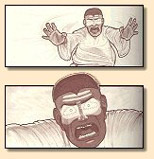
Indy goes back to Willie's room, and we see her
asleep on the bed. He sits down on the bed, and
Willie, half awake, turns to see him behind some
gently swaying mosquito netting. She asks Indy
if Blumburtt believed him, and Indy replies ‘in
a strange monotone' that he did. Willie tells
him that although he's been nothing but trouble
to her, she'd miss Indy if she lost him.
Indy replies ‘You won't lose me Willie...'
and as his face comes towards the mosquito netting
his mouth opens and Willie watches, stunned as
Indy ‘starts hissing grotesquely, smoke billows
out of his mouth and the mosquito netting BURNS
OPEN to expose his terrifying face moving towards
Willie...' Wow. Never mind the kids, most
parents would be scared by this scene. Indy's
eyes glow yellow, and as Willie screams Indy goes
into a rage. The rest of this sequence just has
to be quoted fully for the full effect:
INDIANA
No! I've found it -- you can't --
Kali knows!
Willie tries the
door but it's locked. She sees Indiana moving
toward her ranting incoherently as he smashes
a vase out of his way --
INDIANA
-- been too many lies -- there's no
god's heaven -- just -- the horror!
I've seen it -- life preying on life!
Willie cowers in
a corner, horrified by the transformation she
sees in Indiana. Shouting and pacing Indy holds
his head against the pain of his terrible thoughts
--
INDIANA
-- rivers -- destroying mountains --
a comet in space -- exploding!
(holding his head)
Aaahh! -- the screams -- pitiful
people -- their pain -- the hate --
and greed -- always greed!
The light throws
his shadow over Willie -- a giant shadow floating
back and forth over her as she cries in the corner,
unable to fight the evil devouring Indiana.
INDIANA
-- but I've found -- Kali's touch!
Death -- no more lies -- the death
I've been searching for!
(shouting)
Quit crying! She can hear you --
Kali knows fear -- don't you under-
stand -- Kali is freedom!
Indiana stops pacing
and Willie freezes in terror. Now a bizarre yellow
light wipes across the room. Indiana turns and
watches silently as two Thuggee guards emerge
from a secret doorway that's opened --
The shadows of the
Thuggee guards loom over Willie and she SCREAMS
again!
As I said above, wow. Where did
this stuff come from? Huyck and Katz wrote it,
but what inspired it? Such a pivotal sequence
must have been developed by them, Lucas and Spielberg
together. Who had the most input into it, Lucas
or Spielberg? Spielberg, who was then riding high
commercially with E.T.,
but undergoing turbulence in his personal life?

A Thuggee on fire. |
|
The draft then continues much as
the film, except that Short Round discovers that
fire can wake people from ‘the black sleep
of Kali' when he sees a Thuggee guard splashed
with lava. This scene was filmed, but cut a at
a very late stage - so late that it appears on
one of the Topps trading cards brought out at
the time of the movie.
Shorty burns Indy, waking him up,
and the trio escape, though not before throwing
Chattar Lal down into the lava pit (a sequence
that was storyboarded but never filmed). They
free the slave children, building a makeshift
bridge over the lava pit in the Temple and helping
them across it. But when Indy tries to use it,
it collapses under his weight and they have to
find another way out. The sequence with the makeshift
bridge was partially filmed but dropped from the
final cut (DVD special edition, anyone?).

Preparing mine cart
chase miniatures. |
|
The mine car chase was originally
written for Raiders of
the Lost Ark, but dropped from that film
(see chapter 2 of this article!). It was dropped
into Temple of Doom,
but was meant to be the films second big action
sequence, after the aerial dog fight. As that
sequence was dropped the mine car chase grew and
grew, with input from various ILM
people and more obstacles and incidents being
added, until it became the chase we know. In fact,
some parts were filmed and later cut, including
a shot where the mine car splashes through a pool
of lava, and another where our heroes narrowly
escape a lava avalanche in the tunnels.
After outrunning the Thugees and
the water, they reach the rope bridge, which Indy
cuts, leading to one of the biggest genre in-jokes
of all time - the film's ‘cliffhanger'
ending. However, in the draft the Thugees fire
burning arrows at Indy, causing the bridge to
catch fire. This would have been more spectacular
but made less sense (surely the fire would kill
Mola Ram too?). Indy fights with Mola Ram, and
we see his eyes glow - but the glow disappears
when Mola Ram is burnt by the Shankara Stones,
and he dies unpossessed. Blumburtt arrives with
the cavalry. The final scene in the first draft
is a big improvement on the finished film - no
baby elephant squirting water, just a short happy
scene back at the Indian village.
Although the more horrifying elements
of this draft were removed - I'm thinking
of the chilling mosquito net scene - the film
still caused huge controversy. Not that there
was any more violence in Temple of Doom
than in Raiders (and arguably less) but
the violence in the final film was far more intense
than in Raiders. Over half the film takes place
underground, and the human sacrifice is not a
quick death, but lingered over. These sequences
may not have been Spielberg's idea, but he
directed them; if he had wanted to make them less
intense he could have done so. It is difficult
not to feel that in some perverse way Spielberg
wanted to shock, wanted to get a negative reaction,
perhaps so he could make a break with more ‘juvenile'
films and move on to serious stuff. Temple
of Doom was followed by a string of worthy
films based on award-winning novels (The Color
Purple, Empire of the Sun, Schindler's
List, and, err, Jurassic Park...) and
if he later went back to Indy for the Last
Crusade, it took five years and a number of
failed scripts. So he marked the end of one phase
in his life with an ‘action' film that
was anything but a straightforward adventure movie,
and in doing so created a feel good film that
somehow managed also to be dark and disturbing,
reflecting his own mood. In Temple of Doom
Indy is possessed; Spielberg too is not quite
himself.
As well as the violence, Temple
of Doom was also attacked for its politics,
or what critics imagined its politics to be. Speaking
at the 1984 Republican convention, the then Vice
President George Bush quipped ‘we're
creating our own temple of doom for the Democrats'.
The film was attacked for promoting ‘American
imperialism' and patronizing a foreign culture.
Is this true? Well, I'm staying out of politics.
But it should be possible for a critic to articulate
different viewpoints without necessarily agreeing
with them, just as a film, play or novel can have
more then one ‘meaning'. You can argue
that the film reflected the mood and foreign policy
of the times without promoting a particular political
program in the manner of, say, the Rambo
films. And while Temple of Doom was accused
of being racist in it's depiction of an evil
foreign cult, no one made that accusation at Raiders,
and that too featured an evil cult - the Nazis.
Coming soon - a look at the drafts
for the third Indiana Jones film, in which Indy
goes to Africa, battles ghosts, pirates and Nazis,
and - er - dies?!? Now how does he get out of
that one? Find out in the next thrilling installment
of Raiders of the Lost Drafts!!
Continue
to Chapter 4a >> |